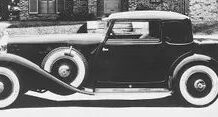
It started with eight Detroit businessmen pooling their cash in February 1909 to launch the Hudson Motor Car Company. You had the retail heavyweight Joseph L. Hudson on the board. Then there was Roy D. Chapin, Sr., who took the helm as president from 1910 to 1923 and steered the firm into serious prosperity. For 48 years, Hudson built some of the fastest, sharpest machines in America. They weren’t always the volume kings, but they were often top-tier sellers until 1950.
The breakthrough came in 1919 with the Essex. It was a low-priced four-cylinder that changed the game. By 1925, Hudson had climbed to third place behind Ford and Chevrolet. They held that third, fourth, or fifth spot through 1929, moving 300,000 cars a year. Then the Depression hit. The market got decimated. Sales plummeted. Had they not had the speedy, affordable Essex Terraplane in their back pocket, Hudson might have folded up shop by 1940.
Why the Hudson Great Eight was a mistake
In the 1920s, Hudson had an enviable reputation. They built big, smooth, solid cars like the Super and Special Sixes. Good performance for the money. Fine reliability. But in 1924, they introduced the Essex Six and decided to move upmarket. They wanted prestige.
The result was the 1930 Great Eight. It wasn’t great at all.
The engine displacement was just 213.5 cubic inches. That was actually smaller than Hudson’s previous sixes. It put out 80 horsepower to move a heavy chassis. Not sturdy. Sure, it had an integrally cast block and crankcase. It was the first straight-eight with a counterweighted crankshaft. But it used a splash lubrication system that was already outmoded. It felt like a step backward disguised as a step forward.
Hudson stuck with this engine for the 1931 and 1932 “Greater Eights.” In hindsight, it was a fatal error for a depressed market where sixes would have sold far better. They did bump up the displacement. First to 233.7 cubic inches and 87 brake horsepower. Then to 254 cubic inches and 101 bhp. But the fundamental mismatch remained.
The body shop crisis
1930 brought another hit. Biddle and Smart, Hudson’s longtime supplier of magnificent open bodies, closed down due to the Depression. Suddenly, Hudson had to turn to Murray and Briggs for phaeton and speedster bodies. A few eight-cylinder models from this period did get dashing coachwork from LeBaron, but that was the exception, not the rule.
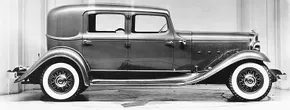
Through 1933, the Hudson Eights offered a bewildering array of styles on wheelbases ranging from 119 to 132 inches. You had roadsters. Victorias. Convertibles. Sedans. Town sedans. Coupes. Broughams—which are just two-door sedans, by the way. It was an attractive line. It would have done justice to far more expensive brands. But it wasn’t working.
Sales figures tell the story. The Greater Eight moved just 22,250 units in 1931. In 1932, despite unchanged prices and lush new Sterling and Major series models, the total dropped below 8,000. The market was rejecting their premium strategy.
The Pacemaker pivot
Hudson finally saw the error of its ways. For the 1933 “Pacemaker” line, they launched a new Super Six. Essentially, they took the 73-horsepower, 193-cubic-inch Essex Terraplane engine and dropped it into the 113-inch Hudson chassis. It was a lighter, more sensible car for the times.
That year, the Eights comprised four 119-inch-wheelbase standard models and five luxurious Majors on a 132-inch platform. Production bottomed out at under 3,000 units. Interestingly, the Eights still outsold the Sixes nearly two-to-one. Customers were clinging to the bigger engines even as the company bled cash.
For 1934, Hudson abandoned sixes in the main line again. They reserved the six-cylinder engines for the new Terraplane line, which replaced Essex as the firm’s “companion” marque. The hierarchy was shifting. The Great Eight era was ending in a whimper, replaced by a pragmatic, if less prestigious, return to smaller displacement. The question remains whether the prestige chase cost them their soul, or if the market just didn’t have the money for vanity plates during the worst economic collapse in history.
Shifting Shapes and Shrinking Margins
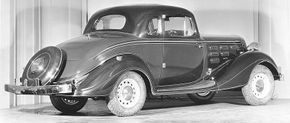
Detroit’s design language was shedding its rigid, Greek-revival boxiness for the aerodynamic curves of streamlining. Hudson followed suit, though the transition was messy. The 1934 and 1935 models sat in an awkward middle ground: still largely square, but softened by skirted front fenders that hinted at what was coming.
Then came 1936.
The new bodies bore a striking resemblance to the Chrysler and DeSoto Airstreams—modern, yes, but far removed from the radical engineering of the Airflow. Hudson opted for tall, rounded grilles that looked suspiciously like Plymouth’s, paired with all-steel bodies that offered safety but little in the way of visual excitement. The lines were dowdy. The engines were too.
The straight-eight engine remained largely unchanged, available across Standard, DeLuxe, and Custom series. The real news was the new six-cylinder introduced for 1935. Displacing 212.1 cubic inches, it started at a modest 93 bhp. By 1936, tune-ups pushed output to 101, and eventually 107. The bigger eight-cylinder options for 1937-38 delivered 122 to 128 bhp. Not groundbreaking, but reliable.
Volume numbers told a worrying story. Hudson seemed hesitant to fully commit to the “potato look” that was becoming industry standard. While the company hit 85,000 units in 1934, securing fifth place nationally, the bulk of those sales came from the low-priced Terraplane sub-brand. Production averaged 100,000 units annually from 1935 to 1937. By volume, that should have been strong. In reality, it dropped Hudson to eighth place in the market. The Terraplane still dominated the lineup.
Worse, the strategy was bleeding cash. Hudson likely slashed prices to compete, dropping below the profit margin. Despite higher output, the company lost money. In 1937, they showed a profit of less than $1 million. By 1938, a recession year, that flipped to a loss of nearly $5 million.
Roy Chapin, who had served in the Hoover Administration, returned as Hudson president in 1933. He made some crucial product calls, only to depart three years later. His successor, A.E. Barit, shifted the firm’s focus entirely. The new direction emphasized economy over performance.
In 1938, the Terraplane marque was dissolved. It was folded back under the Hudson banner after four years of separation. Simultaneously, Hudson launched a new low-priced senior series: the “112,” named for its 112-inch wheelbase.
It was a sluggish machine. Powered by a small 175-cid six producing just 83 bhp, it lagged behind the 96-hp Terraplane engine (which could hit 60 mph in 35 seconds with a top speed barely cracking 70 mph). The 112 was slower, but it offered better fuel economy, returning up to 24 mpg, and started at a very attractive $700. The 212 Terraplane engine continued to power the Custom Six, tuned to 101/107 bhp, while the unchanged eight-cylinder was reserved for a single Custom line.
By 1939, the national economy was recovering. Hudson finally dropped the Terraplane name entirely. The 112 was trimmed down to a single DeLuxe series. They unveiled new Pacemaker and Country Club Sixes, both making 101 bhp, on wheelbases of 118 and 122 inches respectively. The 212-six engine returned, housed in large, comfortable five- and seven-passenger sedans that were curiously dubbed “Big Boy.” The Custom Eight became the Country Club Eight, retaining its power and wheelbase.
These were the final year for the 1936 body shells. Some deft design tweaks alleviated the previous bulkiness. Long-chassis models looked particularly graceful. The grilles changed, too—swapping the controversial “waterfall” vertical bars of 1937-38 for a more horizontal, thick-bar design that gave the front end a more pleasant “face.”
It was a period of consolidation. Survival, rather than dominance.
For more on defunct American cars, see:
-
AMC
-
Duesenberg
-
Oldsmobile
-
Plymouth
-
Studebaker
-
Tucker
1940, 1941, 1942, 1945 Hudsons
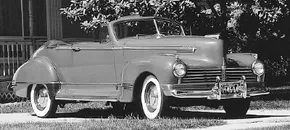
By 1940, Hudson had completely redone its lineup. The new bodies weren’t groundbreaking, but they were clean. You got rid of the fussy side trim. The face of the car featured a trendy “prow front” that split a low, horizontal-bar grille. It looked good. Hudson also proved its metal lasted. They ran a test for over 20,000 miles at an average of 70.5 mph. That set a new American Automobile Association record for durability.
The model range was sprawling. Seven series. Three wheelbases. Three different engines. The entry-level Traveler and DeLuxe sat on a short 113-inch wheelbase. You could get them as coupes, Victoria coupes, two- or four-door sedans, a convertible, or a convertible sedan. They all used the 175-cid straight-six. It was rated at 92 bhp.
Move up the ladder and you hit the 212 engine. It pushed 98 to 102 bhp depending on the tune. That powerplant lived in the Country Club Six and the new 118-inch-wheelbase Super Six. The two “Big Boys” used it too. The old 254 straight-eight didn’t vanish. It still made 128 bhp. The Standard Eight rode on the Super Six chassis and took any body style you wanted. The Country Club Eight stayed on a longer 125-inch wheelbase but shed models. Just one six-passenger sedan and two seven-passenger sedans remained.
Volume didn’t budge much. Total production for the year sat just under 88,000 units. The financial result? Red ink. Hudson lost about $1.5 million for the calendar year.
1941: The Pre-War Shift
The 1941 model year brought a mild facelift. Wheelbases got shuffled again. The DeLuxe and new entry-level Traveler Six moved to 116 inches. The Super Six stretched to 121 inches. The new Commodore Six and Eight took the longest wheelbase at 128 inches. Every series offered two coupes and two sedans. DeLuxe, Super Six, and Commodore lines also listed convertible sedans. Hudson kept this body style longer than almost anyone else. Buyers didn’t want it anymore though. Only about 200 of each series were built.
Wagons were a different story. The Super Six and Commodore Eight wagons were Hudson’s first. They were rare. You could buy about 100 of each. Prices started at $754 for the Traveler coupe. The long-wheelbase Commodore Eight seven-place sedan cost $1,537. Hudson also kept selling commercial vehicles. The 1941 lineup included a car-style pickup that inherited the Big Boy name.
Sales ticked up. Production hit nearly 92,000 cars. Earnings rose to almost $4 million. But that profit didn’t come from selling cars to the public. It came from defense contracts. Those contracts started materializing in early 1941. It was a lifeline.
1942: The War Machine Takes Over
August 1941 saw the arrival of the 1942 models. They looked smoother. Some called them chubbier. The running boards were hidden away. The grille dropped lower and simplified. Fenders bulged out in a more stylish way. Hudson’s famous white-triangle logo sat on the side of the prow. It lit up with the headlamps to help identification at night.
The lineup was mostly the same. Wagons were leaving the fold. A new Commodore Custom Eight appeared. It offered a lush 121-inch-wheelbase coupe and a 128-inch six-seater sedan. Prices sat between $1,300 and $1,400. Minimum prices nudged past $800.
Then the war hit. The government ordered a turn to war production in February 1942. Car output plummeted. Total model-year production ended at just under 41,000. Among those last cars were a handful of Hudson’s final four-door convertibles.
Hudson shifted gears for the war effort. They built “Helldiver” aircraft. They made “Invader” landing-craft engines. They produced sections for B-29 bombers. They worked on Aircobra helicopters. Naval munitions rolled off the lines too. Profits during the war were small. Once V-J Day arrived, Hudson jumped back into consumer car production. Calendar 1945 saw 4,735 cars produced. That put Hudson in fifth place for the year. The brand hadn’t held that rank since 1934. It wouldn’t hold it again.
For more on defunct American cars, see:
-
AMC
-
Duesenberg
-
Oldsmobile
-
Plymouth
-
Studebaker
-
Tucker
1946, 1947, 1948, 1949 Hudson cars
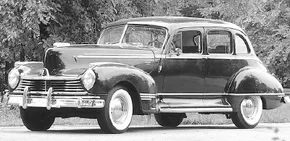
Post-war Hudsons didn’t really innovate much at first. The 1946 and 1947 models were essentially 1942 bodies with minor cosmetic tweaks. They lost that aggressive prow. They kept the humble 175-cubic-inch inline-six. But the lineup got simpler. You could pick between the Super Six or the Commodore, available in Six or Eight configurations, all riding on the same 121-inch wheelbase.
The real news was in the drivetrain. Hudson offered three distinct ways to move forward.
First, the standard stick shift with overdrive, costing just $88. Then there was the “Vacumotive Drive” for $40. This was a semi-automatic system that handled clutch engagement automatically. But the heavy hitter was the “Drive-Master” for $98. It combined the Vacumotive clutch with a full automatic shift. You put the lever in third. The car launched in second gear. Lift off the gas, and it popped into third. Brake to a stop, and it dropped back to second. It was clever engineering, though not without quirks.
Hudson sold over 91,000 cars in 1946. Two-thirds were Super Sixes. The 1947 models saw minimal changes—chrome trunk badges, dual exterior locks, and a slight lip on the grille medallion housing. Production hit roughly 92,000 units. Yet, Hudson’s ranking in the industry dropped from ninth to eleventh. Other brands were capitalizing on the postwar seller’s market better.
Despite the ranking slip, the money was good. 1946 sales exceeded $120 million with a net profit of over $2.3 million. By 1948, that profit would skyrocket to $13.2 million on $274 million in gross sales.
The catalyst? The “Step-Down.”
This was the car that changed everything. Named for its recessed floorpan, the Step-Down architecture placed passengers lower than the running boards and axles. It used strong frame girders to surround the cabin. It was unitized construction, meaning the body and frame were one piece. This eliminated rattle and provided a radically low center of gravity. The handling was sharp. The ride was smooth, thanks to a 124-inch wheelbase that also created a cavernous interior.
Visually, it was a torpedo. Clean, flush fenders. Modest taillights. Fully skirted rear wheels. A low, horizontal grille. The design came from Frank Spring’s team, who had been sketching aerodynamic forms during the war. They were ahead of their time.
For 1948 and 1949, Hudson stuck with a four-series lineup. They made a mistake common in Detroit: restyling and re-engineering in the same year. The Super and Commodore Sixes got a new 262-cid inline-six. It produced 121 horsepower. That was only seven less than the unchanged 254-cid straight-eight. The new six had four main bearings instead of five, but it was smooth. Durable. It finally adopted full pressure lubrication, ditching the old splash method.
Performance was surprising. 0-40 mph in 12 seconds with the Drive-Master. Stick-shift models were faster. With this new engine in the advanced Step-Down platform, Hudson went from also-ran to one of the quickest, most roadworthy cars in America almost overnight.
Dealers loved it. The market was heady. Customers outnumbered cars. Hudson surged. They sold 117,200 units in 1948. Another 159,100 in 1949. The cars were nearly identical, differing only in serial numbers.
But there was a fatal flaw. The unitized design was rigid. You couldn’t change it much without massive expense. Hudson’s sales volume wasn’t high enough to justify a redesign once the postwar boom ended in 1950.
A slow-selling compact from 1953-54 burned through cash reserves. The Step-Down wouldn’t see major updates until 1954. It was too late. Hudson was forced to merge with Nash, forming American Motors.
They couldn’t afford a station wagon. They couldn’t afford a V-8. Both were popular commodities in the 1950s. So, Hudson offered only sixes from 1953 to 1954. Sure, the “fabulous” Hornet engine dominated stock-car racing. But sixes were a hard sell in the medium-price field, which was mostly dominated by V-8s. The engineering was brilliant. The timing was wrong. And by the time they realized it, the party was over.
For more on defunct American cars, see:
-
AMC
-
Duesenberg
-
Oldsmobile
-
Plymouth
-
Studebaker
-
Tucker
1950, 1951, 1952, 1953 Hudsons
Roy D. Chapin, Jr. put it bluntly later. As Hudson’s sales executive and eventual AMC chairman, he admitted the company was broke and reactive. “If you don’t have enough money…you find you just can’t do everything,” he said. Hudson was constantly scrambling. This wasn’t unique. Every independent automaker faced the same trap: low cash meant fewer new models, which meant lower sales, which meant even less cash. It was a death spiral.
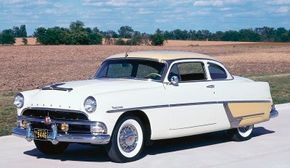
But in 1950, Hudson looked like it had figured it out. They moved more than 120,000 Step-Downs. The star was the Pacemaker. Low-priced, yes, but packed with muscle. The base model sat on a 119-inch wheelbase with a destroked 232-cid Super Six. Only 112 bhp? Sure. But the real-world performance matched Nash’s top-line Ambassador. It crushed rivals in its price bracket.
The lineup was dense. Fastback four-doors, a long-deck club coupe, a convertible, and a two-door fastback called the Brougham. You could even get a three-passenger coupe for just $1,807. The Pacemaker DeLuxe cost a few bucks more and swapped the 232 for a 262 Super Six pushing 123 bhp. The Commodore Six and Eight cut the two-door sedan. The Super Eight axed the convertible. Stylistically, they just added twin diagonal bars to the grille, keeping that iconic triangle motif alive.
Transmission choices got weird. Hudson offered the “Supermatic.” It wasn’t automatic. It was a semiautomatic with overdrive that kicked in at 22 mph via a dashboard button. $199 extra. The Drive-Master cost $105. Neither beat a true automatic, which finally arrived in 1951. Hudson bought GM’s Hydra-Matic for $158 and ditched the Supermatic immediately.
Then came 1951. The Hornet.
This was the big news. A four-model line priced to match the Commodore Eight ($2,543 to $3,099). The engine was massive: 308 cubic inches. The largest American six since the war. Stock output was a modest 145 bhp. It didn’t need more power. It needed precision tuners.
Marshall Teague was the guy. He claimed he could pull 112 mph from a stock Hornet, AAA or NASCAR certified. Hudson engineers weren’t just watching; they were building “severe usage” options. Racing parts disguised as factory extras. By late 1953, they had the “7-X” engine. 0.020-inch overbore. Special cam. Larger valves. Higher compression. Twin-H Power with dual carbs. Hudson claimed it was the first twin-manifold setup for a six.
On the track, the Hornet was untouchable. Teague dominated the 1952 AAA season with a 1,000-point lead. He won 12 of 13 events. NASCAR followed suit. Herb Thomas, Dick Rathmann, Al Keller, and Frank Mundy drove Hornets to 27 wins in 1952. Another 21 in 1953. 17 in 1954.
Winning doesn’t pay the bills, though.
Sales kept falling. Production couldn’t keep up with the hype. The Hollywood hardtop coupe arrived in 1951, the last new body style for a while. The Super Eight and base Pacemaker vanished that year. A facelift brought massive full-width grilles and bigger rear windows.
In 1952, the Super Six became the Wasp. It got a 127-bhp 262 engine shared with the Commodore Six. Pacemaker and both Commodores disappeared for 1953. The lineup shrank. You had the Wasp coupe and sedan. The Super Wasp, which added the Hollywood and convertible in upmarket trim. And four Hornets on the 124-inch wheelbase. The Hornet six now offered 160 bhp as standard. The 170-bhp Twin-H Power was a factory option.
The numbers tell the real story. Step-Down production plummeted. From 93,000 units in 1951. Down to 45,000 by 1953.
The Korean War did help, briefly. Government contracts pulled in an $8.3 million profit in 1952. It was a lifeline. Then 1953 hit. Losses topped $10.4 million. The war profits evaporated. The cycle continued.
For more on defunct American cars, see:
- AMC
- Duesenberg
- Oldsmobile
- Plymouth
- Studebaker
- Tucker
1953 Hudson Jet, the Hudson Italia
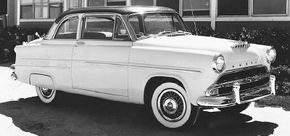
The 1953 Hudson Jet was supposed to be the savior, but the $12 million development bill told a different story. It arrived as a basic notchback four-door and a slightly nicer “Super Jet” with two or four doors. Under the hood, Hudson took the old Commodore eight block, bored it down to 202 cubic inches, and mounted an inline six. Standard output was a paltry 102 bhp. If you wanted speed, you paid for the optional “Twin-H” or high-compression head, pushing output to 114 bhp. That was enough to make the tiny 105-inch wheelbase Hudsons feel quick in a straight line.
Build quality was solid. Road manners were decent. Beauty? Not so much.
Chief designer Spring wanted curves. President A.E. Barit wanted slab sides. Barit won. The result was a bolt-upright, utilitarian shell that failed to spark joy in the showroom. Hudson tried to pivot in 1954. They dropped the cheap Family club sedan at $1,621 and introduced the luxury Jet-Liners for roughly $2,050. Sales didn’t budge. They plummeted from 21,143 units to just 14,224. The market had spoken. The Jet was a ghost.
The Italia Project
Amidst the wreckage, there was a spark. Spring initiated a project to create a true replacement for the aging Step-Down lineup. He called it the Italia. It was a four-place gran turismo, designed by Spring and bodied by Carrozzeria Touring in Milan. The chassis was still the Jet’s, but the execution was advanced.
The list of features read like a wishlist for every enthusiast who ever wanted a European feel in Detroit:
– A wrapped windshield
– Roof-integrated doors
– Fender scoops feeding air directly to the brakes
– Flow-through ventilation
– Form-fitting leather seats
– A stance 10 inches lower than the standard ’54 Step-Downs
It was beautiful. It was also flawed.
The 114-hp inline six couldn’t pull the weight. The aluminum body was fragile. Hudson lacked the capital to fix either problem. So, they built 25 “production” Italias, one prototype, and an experimental four-door derivative called the X-161. Spring’s 161st design project? Maybe he was tired.
Roy Chapin Jr., project sales manager, dumped them at $4,800 a pop. “I got rid of them,” Chapin admitted later, “but it wasn’t one of my greatest accomplishments.”
The Last Gasps
The 1954 Step-Down suffered the same fate. Hudson somehow scraped together funds for a one-piece windshield and a reskin below the beltline. It gave the car a fashionable GM squareness. It also gave it an unfortunate resemblance to the dumpy Jet. They added cheap Hornet Specials—club coupes and two fastback four-doors—for around $2,600. It didn’t matter. The Step-Down was too old to sell. Production for the model year ended at a meager 36,436 units.
Rumors swirled. A merger with Nash was imminent. It wasn’t a rumor. George Mason, Nash’s president, had terms. One condition stood firm: The Jet had to go. Barit resisted, briefly. He had no leverage.
From January 1, 1954, to its death as an independent in April, Hudson lost over $6 million on $28.7 million in sales. Nash didn’t just buy a company. They bought the right to kill its worst ideas.
1954, 1955, 1956, 1957 Hudsons
The End of the Hudson Line
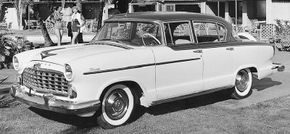
By the time George Romney took the helm after Nelson Mason’s sudden death in October 1954, the dream of a four-way Detroit merger was dead. Mason had wanted to fuse Nash, Studebaker, and Packard into an American Motors Corporation (AMC) powerhouse. Instead, Romney bet the farm on compacts. The Hudson plant in Detroit shuttered. Production moved to Kenosha, Wisconsin, where they retooled the Nash factory for a 1955 model that everyone knew was just a Nash in a new skin.
It wasn’t a bad disguise. The 1955 Hudson kept unit construction and the all-coil suspension that made Nash cars ride so well. Stylists went to town masking the parent company’s identity. They swapped in a heavy egg-crate grille. They cut a distinct rear end. They opened up the front fenders fully, ditching the Nash semiskirts. The only giveaway? The 1954 gauges carried straight over.
The lineup was split by wheelbase. The Wasp Super and Custom sedans, plus the Custom Hollywood hardtop, rode the 114.3-inch Nash Statesman frame. Power came from the 202 cubic-inch Hi-Torque six, a carryover from the Jet. The Hornet Six sat on the longer 121.3-inch Ambassador platform. It offered the same body styles but moved up to the 160 or 170 horsepower versions of the 308-cid engine. The top dogs were the Hornet V-8s. They ran Packard’s new 320-cid V-8, a 208-horsepower powerplant that remained from Mason’s original merger plan.
Twin-H Power was still an option on the sixes. Even the tiny Metropolitan and the compact Rambler got Hudson badges to stretch the brand’s reach. Sales hit a record high in Detroit, but volume was shrinking. Only a little over 20,000 Hudsons rolled off the line.
Then came 1956. The models dropped. The styling turned into what critics now call the “V-Line” disaster. AMC design chief Edmund E. Anderson gets the blame for making what some later called the ugliest Hudsons of the era. The Wasp was reduced to a single four-door sedan. The Hornet V-8s vanished in March, replaced by Hornet Specials. These came with AMC’s new 250-cid V-8, which made a pathetic 190 horsepower. Bad looks and weak power killed demand. AMC built just 10,671 non-Rambler Hudsons that year.
1957 didn’t fix the styling. It did fix the horsepower. They bored out the AMC V-8 to 327 cubic inches, pushing output to 255 bhp. The line now included Hornet Super and Custom sedans and Hollywoods. But the damage was done. Buyers had already labeled the Hudson a loser. Only 3,876 made it out the door.
With that, Hudson was dead. Nash went with it. For 1958, AMC introduced the Rambler Ambassador. It had clean new styling, originally designed for the Hudson and Nash lines. It was the sensible move. As Roy Chapin, Jr., later put it, they had to spend their money and effort on the Rambler. Two once-great names expired. Hudson, with its performance history and engineering legacy, felt like the greater loss. You have to wonder what it might have become if the merger had held together.
For more on defunct American cars, see:
-
AMC
-
Duesenberg
-
Oldsmobile
-
Plymouth
-
Studebaker
-
Tucker