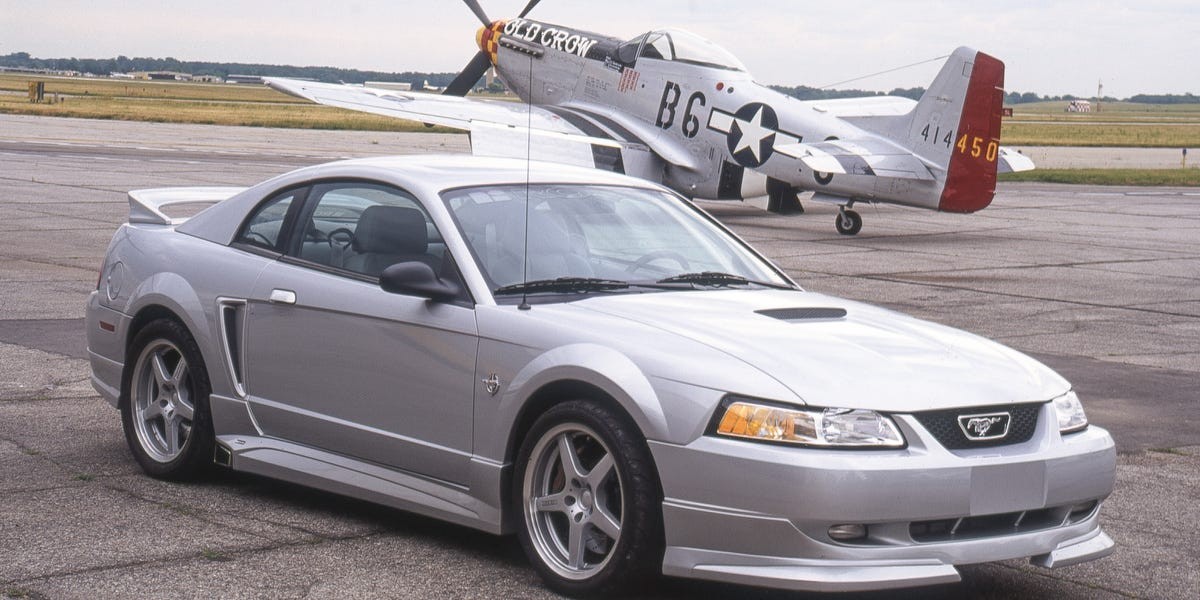
“How about this? One hits 162 miles per hour. The other? 437.”
I stood there, talking to Car and Driver’s senior tech editor Don Schroeder and our photographer, Aaron Kiley. “Or this? One has a wingspan 32 feet wider than the other’s. And, hey, both are painted silver.”
“Weak,” Kiley said. “Really weak.”
“Try again,” Schroeder urged.
I wiped sweat from my brow. “Okay. Ground clearance. Six and a half inches. Vs. 41,900 feet.”
Schroeder stared at me. He looked like he was examining a piece of art created by a toddler.
“Fine,” I blurted out. “One has six machine guns. The other… well, it doesn’t seem to have any weapons.”
Silence stretched across the newsroom. Heavy. awkward. Finally, Schroeder spoke. “John, we’re running a magazine, not a comic strip. Why don’t you just tell the readers the truth?”
Kiley, a private pilot himself, leaned back. “He’s onto something.”
The Hangar King
Jack Roush isn’t just a car guy. The 57-year-old is a titan. He owns five Winston Cup teams. Two Busch teams. Two Craftsman Truck teams. He also built the Oldsmobile V-8 that took the checkered flag at the 1998 Indy 500. And, crucially, he owns three airplanes.
One is the commuter. A brand-new Cessna CitationJet. Twin-engine. Eight passengers. Roush bought it for range—1,600 miles. He claims he can fly from Detroit to Las Vegas without refueling. He flies it every Tuesday to his North Carolina shops. Ninety minutes each way. It’s fast, efficient, and easy to pilot solo. On Fridays, it takes him to races. Sonoma. Loudon. The whole circuit.
The second plane sits in the corner, gathering dust. A 1944 North American AT-6 trainer. Roush doesn’t really fly it. He just likes looking at it. A paperweight with wings.
The third is his soul. A North American P-51D fighter. Built in 1944.
This isn’t some restored relic. It’s a proper interceptor, fitted with its original Plexiglas canopy—a rarity, arguably rarer than finding a ’66 Mustang convertible with its original canvas top intact. Roush had it painted to mimic the “Old Crow,” the fighter flown by ace C.E. “Bud” Anderson during WWII bombing runs over Europe. The irony? This specific Mustang never saw combat. It trained in ’44. It trained in ’45. Then it went to the Canadians. Roush bought it seven years prior to this article.
The Perfectionist’s Project
When Roush took delivery, the P-51 was airworthy. But Brenda Stricklin, his administrative assistant, wasn’t buying it.
“It wasn’t perfect,” Stricklin recalls. “And Jack is a perfectionist.”
“I thought I’d just redo the engine,” Roush says, smiling at the memory. “Then I thought, better fix the hydraulics. Add some avionics. Fix the electrics. You know. All of it.”
Stricklin interrupts. “Everything.”
The restoration took ten months. Today, the plane is valued between $1.4 million and $1.8 million. You can buy a rough P-51 for $800,00, Roush notes, “but that sum represents, what? Two original Cobras?”
He laughs. “A P-51 is more fun. More fun than four Cobras.”
Flying at 42,000 feet puts you above the commercial traffic. Roush wears a Nomex flight suit and an oxygen mask when he climbs that high. The Mustang cruises at 380. Roush has pushed it over 400. During WWII, dive-bombing runs saw speeds of 505 mph—75% the speed of sound.
“My CitationJet cruises at 42,” he says. “So, not that different. But the P-51 gets 5 mpg. The jet? 3.8 mpg. With 250 gallons of fuel, I can fly non-stop from Detroit to Daytona. Just under four hours. I only go to two other races in it. Charlotte. Talladega.”
The plane’s history is as colorful as its paint job. It has two “incidents.”
“I burned a piston coming back to Detroit once,” he admits. “Engine was shaking. Smoke started pouring out. If there’s one thing I know, it’s that engines work fine until you let the smoke out.”
He made a successful emergency landing in Toledo.
Less successful was Oshkosh. A hired pilot landed the plane, but the right landing strut didn’t deploy. “Took a hit. Tore up the prop. Damaged the right wing. Tore off the bottom scoop. Tore off a flap,” he says. “I had it fixed in six weeks. The structure is strong. You’d think they’d be wreckable, but they’re not. As long as you have spare parts.”
The Dynamo’s Secret Stash
Roush has spare parts.
He owns 16 Rolls-Royce V-12 engines. Four are ready to go right now. “I know it sounds like overkill,” he confesses. “But I feel like the keeper of the flame.”
Many of these engines ended up on riverbeds, salvaged from hydroplane racers. Roush wants a future mechanic to have the parts he’s collected. Each V-12 weighs over a ton, aluminum block included. Originally built by Packard under license. With a two-speed supercharger and Roush’s custom roller rockers, they make “around 1,500 horsepower.” Guys who race them in Reno get 2,500 to 3,000 out of them.
“A Mustang at Reno averages 450 mph,” he says.
When he flies, he packs special tools. Two spare magnetos. A voltage regulator. A spare tire. He even bought a second P-51—a 2F model with dual controls—to restore. He is his own Mustang club.
Roush holds an airline transport pilot’s license. He has type ratings. The CitationJet certification required 11 days in Wichita.
“Eleven days with no racing,” he says, shaking his head. “Almost killed me.”
The P-51 itself? Notoriously hard to fly. Add full power at low speed, and the torque can flip the plane faster than a pilot can recover. To survive it—and get lower insurance rates—Roush spent days, weeks, months at a dedicated flight school in Florida.
“It cost me more than my first house,” he admits. “But pilots have a saying. Takeoffs are optional. Landings are mandatory.”
He got nervous soloing. “I remember handing my straw hat to someone. ‘Will you hold this? I’m not sure, but I might need it later.'”
Now, it’s his therapy.
“He zones out,” Stricklin says. “At a race, they wreck everything. He’s furious. In the air? Totally calm. I don’t know how it works.”
The Paper Comparison
Roush demonstrated the P-51’s speed at Willow Run Airport. He pulled 4.4g. Half its limit. He took off near full power so Schroeder could measure the acceleration.
Here’s the data. Up to 130 mph, the P-51 lags the Roush Stage 3 car. A few seconds behind.
Then physics kicks in. The car’s thrust dwindles. The plane? It keeps climbing linearly. At 200 mph? Both Roush and the Mustang are just seagull-sized specks. The cargo jets waiting to take off queued up again.
The Pony You Can Take Home
There is another Mustang in this story. The one Roush lets us keep.
The Roush Performance Stage 3.
You can buy this in two ways. Drop off your GT. Pay $17,000. Wait two weeks. Or pay $39,000 lump sum. Roush buys a new GT, mods it, and hands it to you before it touches a city street.
The mods are aggressive.
- Engine: SVO cylinder heads. Roots-type supercharger. 335 horsepower. 75 up from stock.
- Suspension: Beefier anti-roll bars. Bilstein shocks. Stiffer springs.
- Wheels/Tires: 18-inch wheels. 9-inch wide. Nearly treadless BFGoodrich g-Force T/As.
- Brakes: Six-piston Baer/Alcon calipers. 14-inch cross-drilled rotators. Stock brakes gone.
- Looks: Aggressive fascias. Side exhausts. Aircraft-size spoiler.
- Interior: Restuffed seats with aggressive bolsters. 19 Roush logos to remind you who you are, even if a minor head injury knocks you out.
Schroeder drives it. “It looks macho,” he notes. “Obviously modified. Without pandering to 19-year-old boys. Although the side exhausts come close.”
The Drive
First thing you notice? Noise.
Half the exhaust exits a couple of feet south of your earlobe. On the freeway, it’s a basso-buffo drone that can annoy. The ride is borderline harsh. Steering is nervous. Prone to bump steer.
But the power? Silent.
No whine from the supercharger. No wheeze. Just seamless, fluid power all the way to 6,000 rpm. Peak torque hits low, at 3,800 rpm.
On the skidpad? 0.94g. That’s 0.06g more than an independent-rear-suspension SVT Cobra. If you exceed the limit? The front end dissolves into understeer. Surprising for a Mustang. But it won’t kill you.
The stats don’t lie.
- 0-60: 4.9 seconds. (0.6 quicker than a stock GT).
- Quarter-mile: 13.5 seconds at 06 mph. (Better than a Camaro Z28 by 0.3 seconds and 2 mph).
- Top Speed: 162 mph.
It’s almost identical to their supercharged project car, which Roush also built for $4,694.
The only weak spot? Braking.
181 feet to stop from 70 mph. That’s “superior” to the last two Cobras tested. Barely. The huge Baer brakes ought to be better. Roush is investigating.
He’s also working on the warranty details. Given our project car’s mechanical setbacks? Those details matter.
The Verdict
Every editor who drove the Stage 3 walked away smiling. And deaf.
It’s a hard-core sports car. Razor-sharp reflexes. Flinty ride. It hates the commute. It loves 0.9g cornering.
It is a P-51 in Mustang clothing. Unique styling. Unique performance.
Explaining $40,000 of Mustang to your spouse? Good luck. You’ll need inventive gum-flapping.
While you’re at it, maybe save another $1.4 million. Buy the real thing. The one that flies.