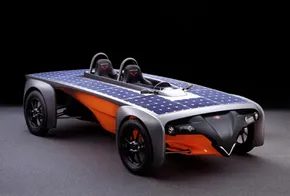
Venturi Automobiles has spent the last seven years proving that electric vehicles don’t have to be boring. Based in Monaco, the company pushes boundaries with concepts that are advanced yet actually buildable. One of their standout ideas is the Venturi Astrolab Solar Commuter. It’s an electro-solar hybrid. The design is athletic. The energy efficiency is extreme.
The name says it all. “Astrolab” comes from Latin roots: astro for star, and labe to take. It’s a vehicle that takes energy from the sun. Solar panels on the roof recharge the batteries while you drive. You can also plug it in.
Venturi unveiled the Astrolab at the 2006 Geneva Auto Show. It was called a pioneering autonomous-energy vehicle. The next year, they took it to Los Angeles. The mayor inspected it. It drove in city traffic. It was also displayed at the Wired NextFest Show.
Saving Every Gram
Designer Sacha Lakic cared about one thing: weight. Less mass means better performance from a small motor and battery. He looked at Formula 1 cars for inspiration. Carbon chassis. Aluminum suspension. The result is an empty weight of just 617 pounds (280 kilograms).
The carbon-fiber body has aqua-dynamic lines. It looks like a modern racing yacht. Riding it feels like sailing. You glide silently. You are propelled by natural energy.
Design and Dimensions
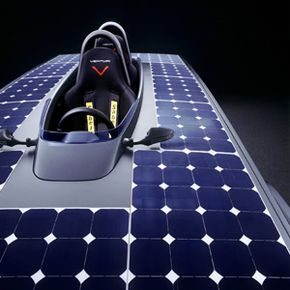
The Astrolab is trim and sporty. It’s also practical. Solar panels cover 11.8 square feet (38.75 square meters) of horizontal surface. The car is short. It measures just 12.4 feet (3.8 meters) long. The width is 1.84 meters (6 feet). The wheelbase is 98 inches (2.5 meters).
The passenger tub is a lightweight protective cell. F1 engineers use similar designs to keep drivers safe in crashes. The two seats are in tandem. They are centered. This placement keeps the ultra-light vehicle stable with two people aboard.
Powering the Astrolab
An air-cooled 16 kilowatt electric motor powers the Astrolab. It’s rated at 3,500 revolutions per minute (rpm). It produces 50 newton-meters (37 pounds/feet) of torque.
A liquid-cooled NiMH Venturi NIV-7 battery pack provides the energy. Innovative charging technology lets the Astrolab restitute battery energy from either the solar panels or a plug-in charger.
The photovoltaic cells in the solar panels are covered with nano-prisms. These concentrate solar energy effectively. The four-wheel disc brake system also recovers energy during braking. It takes five hours to fully recharge the battery pack using the onboard plug-in charger.
Zero Emissions
You can drive the Astrolab on stored solar energy alone. It runs without fossil fuels. It is a true zero-emissions vehicle. If you plug it in, the electricity might come from fossil fuels. Venturi says their environmental actions offset any greenhouse gases created during electricity production.
Sacha Lakic: The Designer
Sacha Lakic is a Serbian designer. He is self-taught. He started designing professionally at age 17. He interned at Peugeot. He became chief of the Department for Vehicles at Alain Carré Design Studio in 1986. He moved to Yamaha-owned MBK Industry in 1988. He took on a chief position in motorcycle design. In 1994 he started his own studio. Since 2000, he’s been an exclusive designer for Venturi Automobiles.
He describes the Astrolab as “a flying wing set on four wheels.”
The Astrolab points the way to zero-emissions driving. It’s a concept that proves electric vehicles can be elegant. It can be efficient. It can be fun. The future of transit is here. It just needs time to catch up.
The Astrolab’s Real-World Range and Solar Efficiency
Road testing has been rigorous, and the verdict is in: the Venturi Astrolab concept is ready for the daily grind. If you start the morning with a full battery, the electric vehicle covers up to 68 miles (110 km). That range isn’t static. On a typical day, the integrated solar cells chip in, adding about 11 miles (18 km) to the total distance. It’s not magic, but it’s effective energy harvesting. Top speed sits at a modest 75 mph (120 km/h), which is perfect for city weaving and inter-urban hops, not highway blasting.
The battery pack is the heavy lifter here. Weighing in at 238 pounds (108 kg), it’s built for longevity. Venturi claims the cells can handle more than 2,500 charge cycles. Based on normal usage patterns, the battery should last at least ten years. That durability matters. It shifts the conversation from “how far can it go?” to “how long will it keep going?”
Why the Astrolab Won’t Hit Dealerships
You can’t buy it. Don’t bother looking for a preorder button. Venturi is upfront about this. The Astrolab is a statement piece, not a product.
“The Venturi Astrolab is for now a concept car and won’t be commercialized. We developed it to show how far we can go with the photovoltaic technology and to prove that an electric car can have very good performance with little energy.”
The goal was technical validation. They needed to prove that solar-electric vehicles could be viable without massive, inefficient panels. The Astrolab does that. It meets the needs of inter-urban travel. It sits at the forefront of electro-solar technology. Venturi is particularly proud of the solar yield. They believe the advances made with this prototype pave the way for even higher yields in future models. It’s a head start. A significant one.
The Volage and Michelin’s Active Wheel Tech
Venturi didn’t stop with the Astrolab. At the 2008 Paris Motor Show, they unveiled the Volage. It’s a sleek GT coupe. The headline feature isn’t just the styling. It’s the tech underneath.
The Volage incorporates Michelin’s Active Wheel technology. This isn’t a standard suspension setup. It aggregates the electric engine, braking components, and suspension into each individual wheel. Every wheel is a self-contained powerhouse. This integration reduces weight and complexity. It pushes the boundaries of what a concept car can do.
What This Means for Green Transport
Has this lightweight, sun-powered vehicle given us a glimpse of a fully green future? Maybe. The idea of powering transportation solely with daylight is still a stretch. But the Astrolab proves the concept works. The Volage shows where the engineering is heading. Time will tell if these concepts evolve into production reality. Or if they remain beautiful, functional dead ends.