The pump price just jumped again. You stare at the nozzle, do the mental math, and wonder if it’s time to ditch the internal combustion engine for good. Maybe the thought of trading in your daily driver for a plug-in electric vehicle (BEV) crosses your mind. But range anxiety is real. You want efficiency. You want lower emissions. You don’t want to be tethered to a charging station for three hours after a road trip.
Enter the hybrid car.
It’s the middle ground. But what is actually happening under the hood to squeeze 20 or 30 extra miles per gallon out of a tank of gas? Does better mileage automatically mean a cleaner footprint? And where does the plug-in hybrid fit into this equation?
We’re breaking down the mechanics of the gasoline-electric hybrid. We’ll look at how these systems combine power sources and how you can drive one to maximize efficiency.
Gasoline Power vs. Electric Power
A hybrid is literally a hybrid. It takes the best of the ICE (internal combustion engine) world and pairs it with the electric drive train. To understand the compromise, you have to look at the extremes.
The Gas Car:
1. Fuel tank holds gasoline.
2. Gasoline feeds the engine.
3. Engine turns the transmission.
4. Transmission turns the wheels.
The Electric Car:
1. Battery pack stores electricity.
2. Batteries feed the motor.
3. Motor turns the transmission.
4. Transmission turns the wheels.
The hybrid tries to keep the convenience of refueling at a gas station while slashing the fuel consumption of the first option. It’s a balance of energy density and electric torque.
The Anatomy of a Gasoline-Electric Hybrid
Hybrids aren’t just a gas engine with a small battery slapped on. They are complex systems. Here are the core components that make the magic happen.
The Gasoline Engine
It looks like a standard engine, but it’s tuned differently. Hybrids typically use smaller engines—sometimes four-cylinders where a V6 would live in a conventional car. They use advanced tech to burn cleaner and more efficiently. The engine isn’t always the primary driver.
The Fuel Tank
This is where energy density matters. Gasoline packs a massive punch compared to batteries. To store the same amount of energy as just one gallon of gas, you’d need about 1,000 pounds of battery cells. That weight is prohibitive for most passenger vehicles. The fuel tank remains the main long-range energy source.
The Electric Motor
These aren’t simple starters. They are sophisticated units controlled by advanced electronics. An electric motor in a hybrid is a two-way street. It acts as a motor, drawing power from the batteries to help accelerate the car. But it can also act as a generator. When you lift off the gas or hit the brakes, the motor reverses its function. It captures kinetic energy and feeds it back into the batteries. This is regenerative braking in action.
The Generator
Distinct from the traction motor, this component’s only job is to produce electricity. It’s primarily found in series hybrid setups. It doesn’t turn the wheels directly.
The Batteries
These store the energy for the electric motor. Unlike the fuel tank, which only delivers energy out, the hybrid battery can receive energy. The electric motor puts power back in during deceleration, and the gas engine can charge it while driving.
The Transmission
This is where designs diverge wildly. Some hybrids use conventional geared transmissions. The Honda Insight, for example, uses a multi-gear automatic. Others, like the Toyota Prius, use a fundamentally different architecture that blends engine and motor input continuously.
Parallel Hybrids
In a parallel hybrid, both power sources are connected to the wheels. The gas engine can turn the transmission. The electric motor can also turn the transmission. They can work together.
At low speeds, the electric motor might do all the work. At highway speeds or under hard acceleration, both the engine and the motor kick in simultaneously. It’s a straightforward approach. You get the benefits of electric torque without a complex series setup.
Series Hybrids
Series hybrids operate differently. The gasoline engine never directly powers the wheels. Instead, it acts as a range extender.
The gas engine turns a generator. That generator produces electricity. That electricity either charges the batteries or powers the electric motor that drives the transmission. It’s essentially an electric car with a gasoline-powered generator on board. This setup allows the engine to run at its most efficient RPMs constantly, regardless of vehicle speed, but it introduces efficiency losses in the conversion process.
The Efficiency Paradox of Smaller Engines
The secret sauce of a hybrid car performance strategy isn’t just about adding electricity; it’s about making the internal combustion engine smaller. A conventional car needs a large, thirsty engine to generate enough torque for quick acceleration. A hybrid swaps that V-8 for a compact four-cylinder or even a three-cylinder unit.
Why does shrinking the engine boost efficiency? It comes down to physics and friction. A big engine is heavy. Every time you accelerate or climb a hill, you’re hauling that extra metal around. Inside the block, larger pistons and crankshafts require more energy to move up and down. Larger cylinder displacement means more fuel is injected per stroke. And let’s not forget the cylinders themselves—each one fires and burns fuel even when the car is idling or coasting.
Two identical cars, different engines. On the freeway at 65 mph, both need the same horsepower to maintain speed. But the smaller engine burns less fuel just to run itself. It operates closer to its peak load, where thermal efficiency is highest, while the big engine is loping along at low, inefficient RPMs.
Bridging the Power Gap
So, how does a tiny engine keep up with a Camaro ZL1? It doesn’t. And it doesn’t need to.
In a traditional car, the engine is sized for peak performance. You floor it onto a highway ramp, and the big V-8 screams to provide maximum torque. But here’s the hard truth: most drivers use that peak power less than 1% of the time. The rest of the drive is commuting, cruising, and idling.
Hybrids decouple power from necessity. The gas engine is sized for average power requirements—enough to keep the car moving at highway speeds. When you need to merge fast or climb a steep grade, the electric motor kicks in. It provides the instant torque that the small gas engine lacks. This synergy means the engine never has to oversize itself for rare, high-demand events.
Five Tactics for Maximizing MPG
Beyond the engine swap, hybrids employ specific technologies to squeeze every mile out of a gallon. Some are standard efficiency tricks; others are hybrid-exclusive.
1. Regenerative Braking: Catching the Waste Heat
When you brake, you’re essentially throwing away energy. Kinetic energy turns into heat in the brake pads and dissipates into the air. In a hybrid, that energy isn’t lost.
The system uses regenerative braking. When you lift off the accelerator or tap the brake, the electric motor reverses its function. Instead of drawing power to spin the wheels, it acts as a generator. The resistance slows the car down while simultaneously charging the high-voltage battery. You’re capturing energy that would have otherwise vanished.
2. Auto Start-Stop: Killing the Idle
Idling is a waste of fuel. No work is being done, but the engine is burning gasoline. Hybrids with advanced start-stop systems shut off the engine completely when the car comes to a halt—say, at a red light or in heavy traffic. The instant you release the brake, the electric motor or starter engages to restart the engine smoothly. No gas burned while the car is stationary.
3. Aerodynamic Drag Reduction
At highway speeds, aerodynamic drag is the enemy. The engine’s primary job isn’t moving the car; it’s pushing the car through the air.
Hybrids often feature lower rooflines, smoother underbody panels, and even covered wheel wells. These design choices reduce the frontal area and smooth airflow. Less drag means the engine doesn’t have to work as hard to maintain speed, directly improving fuel economy.
4. Low-Rolling Resistance Tires
Standard tires are a compromise. They need to be quiet, comfortable, and grippy in rain or snow. They aren’t built for efficiency. Hybrid cars use specialized low-rolling resistance tires. They’re stiffer and often run at higher pressures. This reduces the flex in the sidewalls and the contact patch friction, allowing the car to roll further on less power.
5. Weight Reduction
Weight is the killer of fuel economy. A lighter car requires less energy to accelerate and less energy to climb hills. Manufacturers use lightweight materials like aluminum, magnesium, and composite plastics in the body and chassis. Every pound shed translates to a slight but cumulative gain in miles per gallon.
The Heartbeat of the Prius
The power split device is the actual heart of the Toyota Prius. You have to respect that. It’s a clever gearbox that hooks the gasoline engine, the generator, and the electric motor all into one tight knot. This is where the magic happens. It allows the car to operate like a parallel hybrid. The electric motor can power the car by itself, the gas engine can power the car by itself, or they can power the car together. It’s flexible.
It also acts like a series hybrid. The gasoline engine can operate independently of the vehicle speed. It just charges the batteries or provides power to the wheels as needed. That’s efficient.
The power split device also acts as a continuously variable transmission. This eliminates the need for a manual or automatic transmission. No shifting. No clutch pedal. Just smooth power delivery. Finally, because the power split device allows the generator to start the engine, the car does not need a starter. That part just doesn’t exist.
The power split device is a planetary gear set. It’s complex but elegant. The electric motor is connected to the ring gear of the gear set. It is also directly connected to the differential. That differential drives the wheels. So, whatever speed the electric motor and ring gear spin at determines the speed of the car. Simple physics. Powerful results.
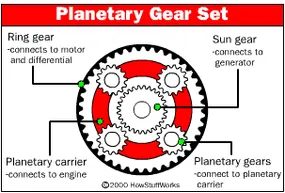
The mechanical heart of the Toyota hybrid system is the power split device, a planetary gear set that manages the flow of energy between the engine, the generator, and the traction motor. It’s not a traditional transmission with gears that shift. Instead, it’s a continuously variable mechanism where the sun gear connects to the generator, and the planet carrier links to the gasoline engine. The ring gear? That’s tied to the output shaft that eventually drives the wheels.
Because these three components are mechanically locked together, they can’t move independently. The speed of the ring gear is the sum of the movements of the other two. They have to coordinate constantly. If one speeds up, the others must adjust their rotation to keep the physics working. This is how the system controls output speed without a conventional clutch or gear box.
When you press the accelerator from a standstill, the gasoline engine stays off. The electric motor and the battery pack do all the heavy lifting. The electric motor is connected to the ring gear, so it starts spinning immediately, pushing the car forward. But here’s the trick: the planet carrier, attached to the engine, is stationary. The engine isn’t running yet.
Since the ring gear is turning and the planet carrier is stuck still, the planetary gears have to spin on their own axes. This spinning motion turns the sun gear. The sun gear is connected to the generator. So, as you accelerate in electric mode, the generator spins up. It doesn’t generate electricity for the battery yet; it just spins to keep the engine disengaged. The generator spins at exactly the speed required to cancel out the motion of the ring gear relative to the planet carrier. This keeps the engine shaft completely still. It’s a elegant mechanical trick.
When the Engine Turns On
This electric-only mode lasts until you reach about 40 mph (64 km/h). At that point, the system decides it’s time to bring the gasoline engine into the mix. The generator suddenly changes its rotational speed. This change disrupts the balance of the planetary gear set. The force transmitted through the gears now causes the planet carrier to turn.
The planet carrier is locked to the engine crankshaft. So, as soon as it starts spinning, the engine starts running. It’s a smooth transition because the engine is already being rotated by the drivetrain before it fires up. There’s no starter motor needed to get the engine moving; the hybrid system acts as the starter.
Once the engine is idling and running, it settles into a constant speed. The generator now changes its speed continuously to match the output needs of the traction motor and the wheels. This allows the engine to operate in its most efficient RPM range, regardless of how fast the car is going. The generator varies its speed to match the output speed with the electric motor, ensuring the engine doesn’t have to lug or rev wildly.
If you floor the accelerator, the electric motor draws extra current from the high-voltage battery to provide torque boost. But once you hit freeway speeds, the car runs on a blend of gas and electric power. All the electricity used at that stage comes from the generator, which is being spun by the engine. The battery is essentially a buffer, storing energy during braking and releasing it during acceleration.
How Much Horsepower Do You Actually Need?
There is a massive disconnect between the horsepower listed on a car’s badge and the power actually required to maintain highway speeds. Most of what a car does on the road uses only a tiny fraction of its total output.
When you cruise at 60 mph (96.6 km/h) on a flat road, your engine is fighting three main forces:
- Aerodynamic drag. Air resistance increases with the square of your speed. Pushing through the air takes power.
- Mechanical friction. This includes rolling resistance from tires, friction in the transmission, axles, and brake calipers.
- Accessory loads. The air conditioning compressor, power steering pump, and electrical systems all draw power from the engine.
For most modern sedans, overcoming these forces at 60 mph requires less than 20 horsepower. So why do manufacturers build engines with 200 horsepower? Because you need that reserve power for passing, merging onto highways, or accelerating out of intersections. That “floor it” moment is the only time you use anywhere near the full output. For the vast majority of driving, you are using a small percentage of the available power.
This efficiency gap is why hybrids are so compelling. They use the electric motor to handle the low-speed, high-torque demands that would otherwise waste fuel.
Hybrid Mileage Tips: Driving for Efficiency
The desire for quick acceleration is the enemy of fuel economy. You’ve probably noticed this at the dealership. A car with a smaller, less powerful engine often has better city and highway MPG ratings than an identical model with a turbocharged or larger engine. More power potential means more fuel is burned to create that potential, even if you don’t use it.
To get the best mileage from a hybrid, you don’t need a new car. You just need different habits. The principles are the same as for any gasoline car, but the hybrid system amplifies the rewards.
Drive Slower
Aerodynamic drag is the biggest factor in highway efficiency. The force of air resistance increases dramatically with speed. At 70 mph (113 km/h), the drag is roughly double that at 50 mph (81 km/h). Doubling the drag doesn’t double the horsepower required, but it increases it significantly. Keeping your speed down, even by 5 or 10 mph, can yield measurable gains in MPG.
Maintain a Constant Speed
Every time you accelerate, you burn energy to increase kinetic energy. When you brake, that energy is dissipated as heat. In a hybrid, regenerative braking recovers some of it, but not all. By maintaining a constant speed, you minimize the energy lost to braking and acceleration cycles. Cruise control helps, but your foot is often better. Anticipate traffic flow and keep the pedal steady.
Avoid Abrupt Stops
This is where hybrids shine. When you brake gently, the electric motor acts as a generator. It resists the rotation of the wheels, slowing the car down while converting kinetic energy back into electricity, which goes into the battery. The harder and quicker you stop, the more the mechanical brakes take over. Mechanical brakes convert that energy into heat and waste it entirely.
If you give the electric motor time to slow the vehicle, it recovers more energy. This is true for gasoline cars too, but the effect is more pronounced in hybrids because that recovered energy is directly usable for the next acceleration. Smooth inputs are not just about comfort. They are about efficiency.
Sources
–