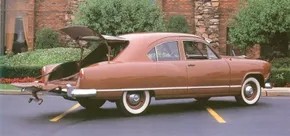
Henry J. Kaiser was said to generate roughly 100 ideas an hour. One of them usually stuck. That singular insight produced the 1951-1953 Kaiser Traveler, the vehicle widely recognized as the first true hatchback. Before this, utility vehicles were distinct from sedans. The Traveler merged them. It was a sedan with the deck and rear window cut out. The result was a car that could carry luggage where a sedan could not.
The origin story is almost too simple to be true. Kaiser traced the outline of double-opening hatches into the dust on a sedan in the Oakland Kaiser garage. The concept was crude: hinge half of the roof to lift up, the other half to flop down. Have them meet in the middle. Done. It looked like a quick fix. It was not.
Engineering the First True Hatchback
Building the Kaiser Traveler required 200 specific changes to the base sedan. The structural loss from cutting the deck meant the car needed reinforcement “all over hell,” according to engineer Ralph Isbrandt. He had to address lost stiffness immediately. The suspension took a hit too. Stronger springs and shocks were installed to handle the increased payload. New floor pan wiring had to be routed. Even the license plate needed a new home.
Harvey Anscheutz, head of body development at Kaiser-Frazer, spent three weeks studying the laws of 48 states. He needed a license plate holder that complied with every position and visibility regulation while the deck was lowered. He found a solution: a lighted holder that flopped down with the deck. No state law was broken. The detail work was meticulous.
Operation required a big, T-shaped handle. A strong piano hinge reinforced the lower hatch. When open, the hatch was suspended by heavy chains. Those chains were bagged in vinyl to stop them from rattling against the body. Anscheutz also designed a folding rear seat. The cushion tilted forward against the front seats. The backrest lowered to extend the cargo platform to seven feet. This folding method is still used in modern wagons.
Early Flaws and the 1951 Fix
The system wasn’t perfect from day one. The 1949-1950 models lacked a sub-floor spare tire compartment. To make room, the left rear doors were welded shut. The spare tire was bolted to the inside panel. Worse, Kaiser installed a dummy outside door handle. It did nothing. Passengers likely pulled on it in frustration, finding no mechanism behind it.
The restyled 1951 Kaiser Traveler solved this. The handsomer body accommodated the spare properly. The dummy handles disappeared. The 1951-1953 run established the template for the hatchback. It proved a sedan could be a utility vehicle without looking like a truck. The Kaiser Traveler didn’t just change how cars looked. It changed how people used them.
The 1951 Kaiser Traveler came in Special and Deluxe trims, available with two or four doors. Those two-door versions did not sell well. Kaiser took some leftover 1951 chassis, re-serialized them, and passed them off as 1952 “Virginian Travelers” to clear inventory. After that, production shifted exclusively to four-door models.
From 1952 through 1953, the four-door Traveler remained the standard offering. Most units rolled out in the base series. Kaiser technically offered a more upscale “Manhattan Traveler” for those years, but production was negligible. At least one example has surfaced in the wild. Sales were sluggish. Only a few thousand units found buyers between 1951 and 1953. The new body style limited cargo capacity compared to previous generations, a trade-off that buyers noticed.
Why the Kaiser Traveler Changed Station Wagons
Think about station wagons in the late 1940s. Boxy. Truck-like. Built largely from wood. The Kaiser Traveler looked and felt different. It was an all-steel, unibody construction. That was a revelation. The Traveler probably did more to normalize the civilized, all-steel wagon than credit usually gives it.
General Motors and Ford were interested. They purchased Kaiser Travelers and disassembled them. Engineers wanted to verify if the structural advantages came with hidden shortcuts. The verdict from one GM engineer was blunt.
“They were pretty good.”
The lineage matters here. The Traveler concept is a direct ancestor to the modern hatchback. Not a perfect parallel, but a clear evolutionary step.
The Seal Problem
Kaiser-Frazer never fully solved the hatch leak. The rubber gaskets between the hatches and the body, and between the hatches themselves, failed. 1950s seal technology was primitive compared to modern standards. Water got in. It got in constantly. If you owned one, you knew about the puddles on the floor.
The Vinyl Upholstery
A lesser-known contribution from the 1951-1953 Travelers was the interior trim. The Deluxe models and the rare 1953 Manhattan featured unique vinyl upholstery. It was pleated and embossed. Kaiser-Frazer worked with the L.E. Carpenter Company in New Jersey. Their interior designer, Carleton Spencer, developed the material using low-pressure refrigerated embossing.
The process was specific. Smooth vinyl was heated and fed into a machine with refrigerated plates acting as the die. The die pressed against the hot vinyl. The design set instantly through heat transfer. Spencer had a nickname for the pattern. He called it “Dragon” and “Dinosaur” vinyl.
“So no one would mistake it for real alligator or real lizard.”
1951-1953 Kaiser Traveler Specifications
The mechanical underpinnings were consistent across the three model years. The engine was a 225.6 cubic inch L-head six-cylinder. It produced 97 horsepower at 3,400 rpm. Torque peaked at 150 lb-ft at 1,600 rpm. The block was made of cast iron. The head was aluminum.
Transmission options included a 3-speed manual or a 3-speed automatic. The automatic used a torque converter. The rear axle ratio was 3.50 to 1. The suspension featured coil springs at the front and a live axle with leaf springs at the rear. Steering was a single-recirculating ball screw type.
The body was all-steel. Wheelbase was 107 inches. Length was 198 inches. Width was 74 inches. Height was 63.5 inches. Curb weight hovered around 3,400 pounds. Fuel tank capacity was 15 gallons. The standard radio was a 3-tube AC/DC model.
Tires were 6.70 by 15 inches. Brakes were hydraulic, with 10-inch diameter wheels. The master cylinder was 1.125 inches in diameter.
How the 1951-1953 Kaiser Traveler specs stack up against the era
The numbers tell a story of compromise. You are looking at a sidevalve I-6 engine. 226.2 cubic inches of displacement, built on a 3.31 by 4.38 bore and stroke. The 1951 and 1952 models pushed 115 bhp. The 1953 update ticked that up to 118 bhp. Not a rocket, but respectable for a car that weighed between 3,210 and 3,370 pounds.
Transmission options mattered. The base setup was a three-speed manual. You could bolt on Hydra-Matic if you wanted automatic shifts. Overdrive was another option. The drivetrain was simple, robust, and easy to understand.
Underneath, the chassis used independent coil springs up front with tube shocks. The rear relied on a live axle and leaf springs. Drum brakes handled the stopping power at both ends. The wheelbase stretched to 118.5 inches. That length contributed to stability, though it made the car feel planted rather than agile.
Why the 1953 Kaiser Traveler feels like a prototype for the modern hatchback
Top speed hit 90 mph. Getting to 60 mph took 15.0 to 16.0 seconds. Those figures put the Traveler in the “leisurely touring” category. It wasn’t about performance. It was about utility.
The real innovation wasn’t in the powertrain. It was the shape. The rear end featured a large, squared-off tailgate. This design feature broke away from the three-box sedan convention of the time. It created a unified cabin-to-cargo space. When you open the rear, you get a continuous area. No tunnel. No awkward cargo well.
This layout anticipated the hatchback by decades. Most cars of the 1950s treated the trunk as a separate compartment. The Traveler merged them. It changed how families and small businesses thought about loading gear. The specs are modest, but the concept was radical.
Which cars actually changed the way we pack our lives? The Kaiser Traveler is rarely in the conversation, but it deserves a spot. It proved that a rear-opening hatch could offer practical space without sacrificing the silhouette of a traditional sedan. The 1951-1953 run remains a quiet footnote in automotive history, one that reshaped utility before the term was even popular.