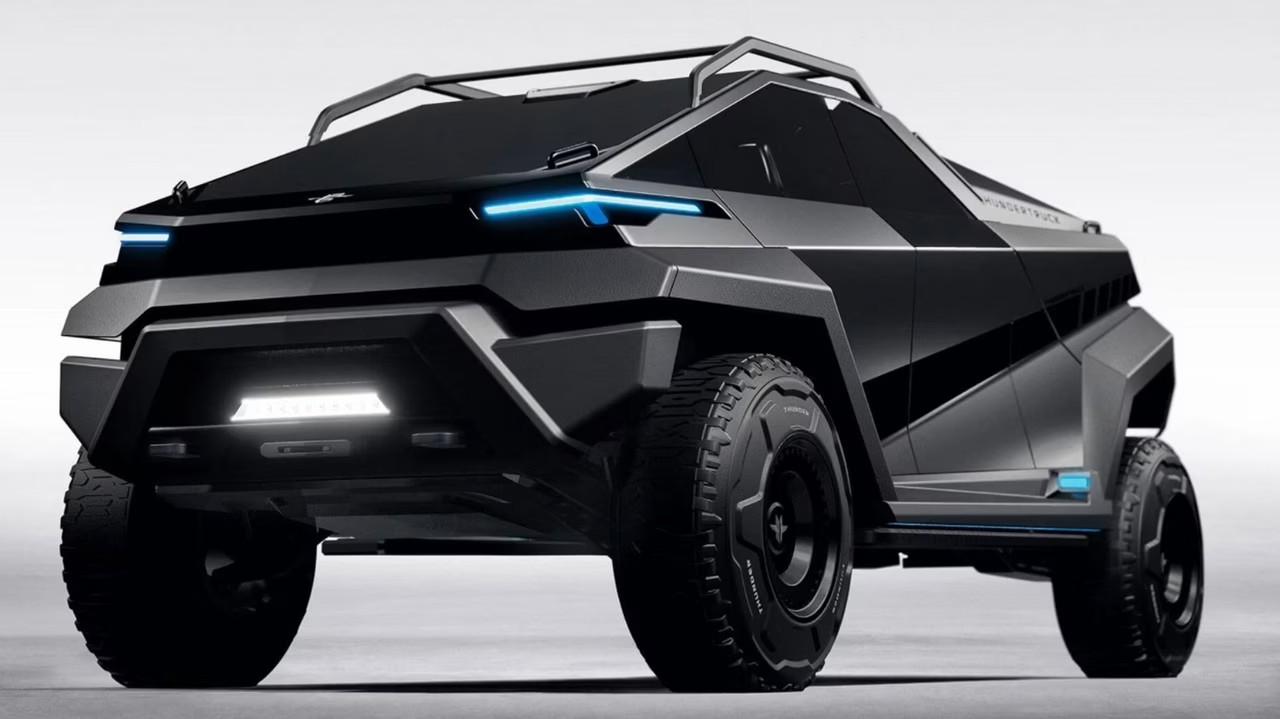
Concept cars are a luxury. They allow designers to ignore reality for a while. Wolfgang LA didn’t just ignore it. He rewrote the rules. The result is the Thundertruck. It is an electric pickup that refuses to fit into a single category. Think of it as a collision between a Cybertruck and a high-tech camper van. The aesthetic is aggressive. The utility is staggering.
The bodywork defines the character. It features sharp, tender angles and vast, flat planes. You see the minimalist DNA of Tesla’s off-road contender immediately. But the proportions tell a different story. This machine sits high. The ground clearance is a robust 37cm. It is not just tall. It is wide. At 2.2 meters across and 5.2 meters long, the Thundertruck dominates the space it occupies.
Performance Specs and Powertrain Details
Power comes from a dual-motor setup. Both units are electric. Together, they push out 800 horsepower. That is serious grunt for a vehicle of this size. The truck sends that power to all four wheels via an all-wheel-drive system. The result? Wolfgang LA claims the Thundertruck hits 0 to 100 km/h in just 3.5 seconds. That is supercar territory for a utility vehicle.
Energy storage is where the range anxiety usually kills electric concepts. Not here. The base configuration includes a massive 180 kWh battery. It is not a small cell pack. It is a substantial energy reservoir. With that capacity, the truck offers up to 640 km of autonomy. That is a significant figure for long-distance hauling or remote camping trips.
“Wolfgang LA didn’t just ignore reality. He rewrote the rules.”
Why This Concept Matters Now
The intersection of truck utility and recreational living is crowded. Yet, most solutions compromise. You lose payload for living space. You lose range for amenities. The Thundertruck attempts to solve that equation with pure scale. The flat surfaces are not just stylistic choices. They are functional canvases. They suggest modularity. You can imagine racks, storage, or solar arrays integrated directly into the body.
Who is this for? It is not for the daily commuter in a city garage. The width alone makes parking a nightmare. It is for those who view their vehicle as a base camp. The high clearance handles rough terrain. The massive battery handles the distance. The horsepower handles the acceleration. It is a statement of capability.
Is it production-ready? Probably not. Concepts like this are often mood boards with wheels. They test waters. They gauge reaction. The Thundertruck asks a simple question. Do we want our electric vehicles to be efficient appliances or adventurous platforms?
Wolfgang LA seems to have answered with “both.” The specs back up the vision. 800 hp. 640 km range. 3.5 seconds to 100. The hardware is there. The software and manufacturing are the next hurdles. But the concept stands as a bold argument for what electric trucks could be. Not just cleaner sedans with beds. But true multifunctional machines.
The automotive industry is moving toward electrification. But direction is still being decided. Some are aiming for efficiency. Others are aiming for experience. The Thundertruck
The Six-Wheel Conversion That Defies Logic
Most off-roaders dream of more grip. They don’t usually dream of hauling a trailer that turns their truck into a six-wheel drive machine. But the Thundertruck concept does exactly that.
Forget the solar panels folding out like an awning. Forget the bed turning into a sleeping tent or the slide-out kitchen drawer modeled after the Rivian R1T. You’re not here for the camping gear. You’re here for the numbers. And the numbers are insane.
The real story is the six-wheel-drive extension module. It’s not just an add-on. It’s a complete performance overhaul.
Think of it as a self-balancing trailer that couples directly to the chassis. Once locked in, the system adds 140 horsepower to the engine. That’s significant. More importantly, it boosts the range to 900 kilometers. That’s real off-grid capability. No charging stations. No plugs. Just pure, unadulterated range.
“The assembly integrates perfectly with the bodywork on paper, transforming the Thundertruck into a dual-axle pickup.”
On screen, it looks seamless. The lines match. The geometry works. The concept treats the trailer not as an afterthought, but as an integral part of the vehicle’s structure. It’s a dual-axle pickup in all but name.
In reality? Probably a nightmare.
Hauling a trailer that complex on rough terrain is a recipe for jackknifing. The physics don’t lie. A rigid coupling to a self-balancing unit on a bumpy trail is asking for trouble. But this is a concept vehicle. It doesn’t have to survive a rocky scramble in the Mojave. It doesn’t have to pass crash tests.
It just has to look good in a render.
There’s also a reconnaissance drone housed on the roof. It takes off from the Thundertruck to scout ahead. Practical? Maybe. Cool? Definitely. But it’s secondary to the main event.
The six-wheel-drive conversion is the headline. It’s the fantasy of every gearhead who thinks four wheels aren’t enough. It’s the ultimate expression of “more is better.”
Will it ever be built? Probably not. The engineering hurdles are too high. The weight distribution issues too severe. But that’s the point of concepts like this. They show us what’s possible when you stop worrying about cost and start worrying about pure capability.
The Thundertruck doesn’t just go off-road. It reinvents what off-road means. Six wheels. 900 kilometers of range. And a drone watching your back.
It’s beautiful. It’s impractical. It’s exactly what we need to see.
The Track Days That Define the Legacy
You don’t just buy a BMW M3 for Sunday brunch. You buy it for the moment the pavement ends and the adrenaline begins. The E30 generation set the template. Cheap enough to kill. Fast enough to worship. But it was the later models that really separated the enthusiasts from the weekend warriors.
Take the 1995 M3. The S50 engine. 286 horsepower. A six-speed manual that felt like shifting gears on a tank. It wasn’t just about straight-line speed. It was about mid-corner grip. The suspension geometry had been tweaked. Stiffer springs. Heavier anti-roll bars. The car planted itself to the tarmac.
Why the E36 M3 Changed the Game
The E36 didn’t look as aggressive as its predecessor. The lines were smoother. More aerodynamic. Less boxy. But underneath? Pure racing DNA. The S52 engine was a detuned S50B32. Or so we thought.
Car enthusiasts realized something strange. The E36 M3 had a higher redline. 7,200 RPM. That extra breathing room meant you could keep power in the upper band longer. It changed how you drove it. You couldn’t just lug the gears. You had to work the engine.
- Engine : 3.2L inline-six
- Power : 321 hp at 7,400 rpm
- Torque : 258 lb-ft at 3,600 rpm
- Weight : Around 3,100 lbs dry
This weight-to-power ratio was sweet. Not as light as the E30, but the chassis was more rigid. Twist resistance improved. Body roll decreased. You could carry more speed into a corner. The steering felt heavier. More communication. Less numb.
The E46: Peak Analog Driving
Then came the E46. The last M3 with a naturally aspirated inline-six before the turbo era took over everything. The S54 engine. 338 horsepower. A beautiful sound that screams until 8,000 RPM.
Drivers loved the balance. The front suspension used double wishbones. The rear used a multi-link setup. It was complex. It was expensive to fix. But it worked. The car felt neutral. You could flick it left or right without hesitation.
“The E46 M3 is the last true analog sports car from BMW. Before electronic aids took over, it was just you and the machine.”
The SMG transmission was controversial. Quick shifts, yes. But clunky. Unpredictable. Most purists stuck to the six-speed manual. The gated shifter. The mechanical connection. You felt every gear engagement. Every shift was a physical action.
Comparing the Legends: Which One Wins?
If you’re looking to buy one today, the choice isn’t clear. Each generation has flaws. Each has strengths.
E30 M3 :
– Cheapest to buy.
– Hardest to maintain.
– Parts are everywhere.
– Raw. Unfiltered. Dangerous.
E36 M3 :
– More power.
– Better daily driver.
– Less thrilling to drive.
– Still affordable