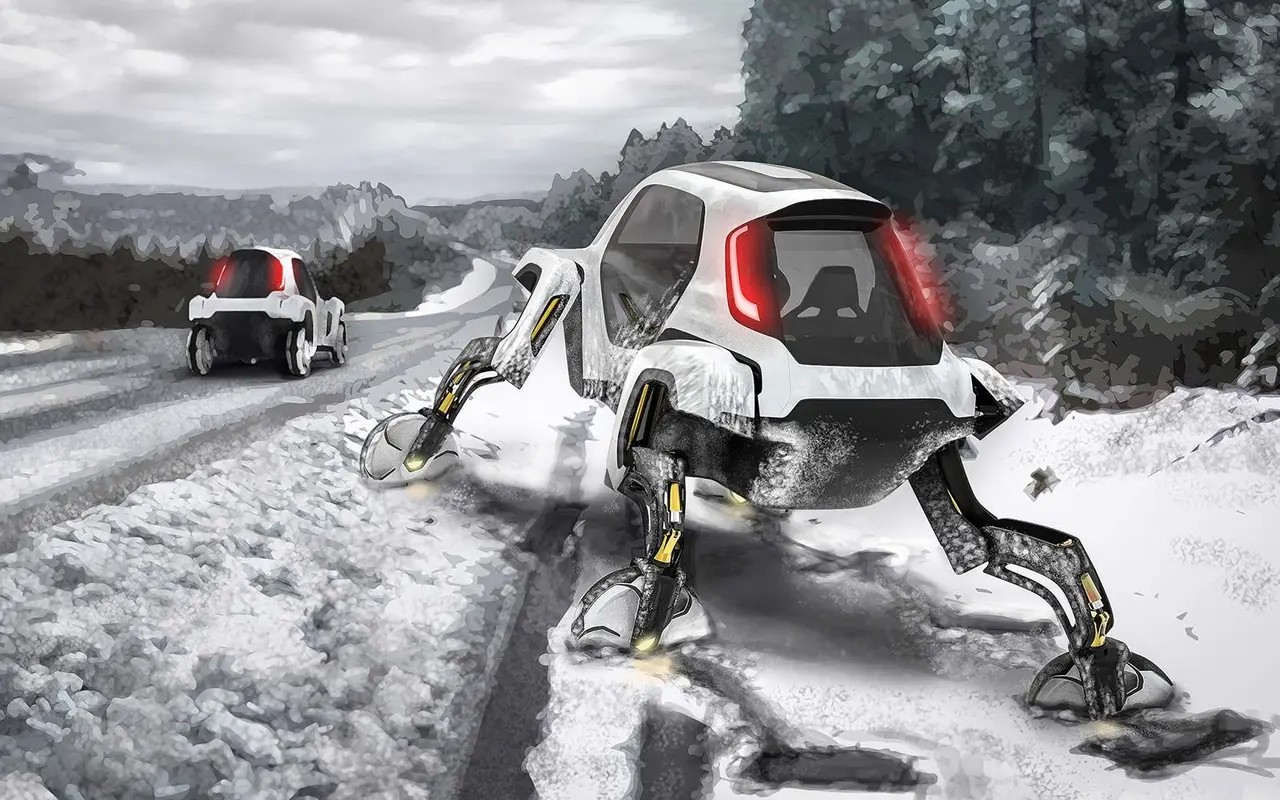
Forget flying cars that promise to solve your commuting problems. Hyundai bets on something more down-to-earth, but also more exotic. the Korean automaker presented the Elevate concept at CES, a concept that doesn’t just drive—it walks. It is an electric car based on articulated legs with five degrees of freedom per wheel. The result? This machine looks less like a car and more like a robotic beast designed for post-apocalyptic scenarios.
How the Hyundai Elevate Actually Moves
Here is the mechanic, stripped of marketing fluff. The Elevate uses wheel-hub motors. There is no complex connection between the chassis and the wheel because the wheel is “just” a leg. The cockpit is a replaceable module that attaches to this mobile chassis. This modular design isn’t just for show. This allows Hyundai to adapt the vehicle to various tasks, primarily search and rescue, but it has also been hinted that it could also be useful for people with reduced mobility.
When it’s in \, Elevate does not trot like a horse. It moves like a reptile or a mammal, adjusting their gait according to obstacles. The specs are staggering for a concept. It can traverse an 1.5-meter-high wall. It can span a 1.5-meter gap. The track width extends to an incredible 4.5 meters to maintain stability when climbing or through uneven terrain. Best of all, the cab stays completely flat. No motion sickness. No rolling over. Just steady, robotic precision.
Why This Matters for Off-Road Enthusiasts
You might be wondering why we are building a walking car. The answer lies in the problem of the “last mile” of off-road driving. Traditional four-wheel drive vehicles are limited by ground clearance and approach angle. They slip, get high-centered or get stuck. Elevate treats the terrain as a series of separate steps instead of a continuous surface.
Imagine a scenario. Your car is stuck in a snowdrift just 3 meters from the highway. In a regular SUV, you have to dig. In the Elevate, you step over the drift. You walk up dangerous slopes. Climb the collapsed building and rescue the survivors. Hyundai’s pitch is visceral. “Imagine a car stuck in a snowdrift just 3 meters from the highway and able to walk or climb over dangerous terrain to get back on the road to rescue injured passengers.”
It’s a compelling fantasy. But for now, it’s just a model. A maquette. We don’t know if a full-scale working prototype will ever be hit the road. The technical challenges are enormous, including power density, weight distribution, and battery life while walking vs. driving. But in theory it can solve problems that even the most expensive rock crawlers can’t.
The Santa Fe: A More Concrete CES Debut
While the Elevate grabs headlines for its sci-fi limbs, Hyundai hasn’t neglected practical innovations. They also introduced biometric technology for the first time in the Santa Fe SUV. This is nothing fancy. It’s integration.
The system reads fingerprint information from the door handle and the engine start button. This is not just a about security. When the car is recognized, it automatically adjusts functions related to seat position, mirror angle and driver profile. Hyundai claims that its sensors can detect varying degrees of conductivity in the fingertips, making it difficult to spoofing with fake fingerprints. It’s clear that hackers are testing this, but it’s a step toward seamless, personalized vehicle entry without keys or cards.
The Verdict on the Walking Car
The Elevate is impressive because it redefines the relationship between the vehicle and the ground. It anticipates that the terrain of the future will not be an obstacle, but an interface. But enthusiasm needs to be tempered with reality. It’s a concept that originated in robotics research, and it could utilize technology developed for disaster response drones and military exoskeletons.
Will we see this on the road? Probably not in the next decade. The complexity is too high, the cost is too high, and the use case is too narrow to fit the mainstream market. But as a demonstration of what can happen when robotics is applied to automotive design, it’s a groundbreaking moment. It shows that cars are no longer just machines for the road. It is a suitable base for any surface.
The Santa Fe fingerprint sensor will be in showrooms soon. Elevate is a vision, a vision of the future. In the future, we will not only be able to drive over obstacles, but also walk over them. Honestly, it’s very beautiful.