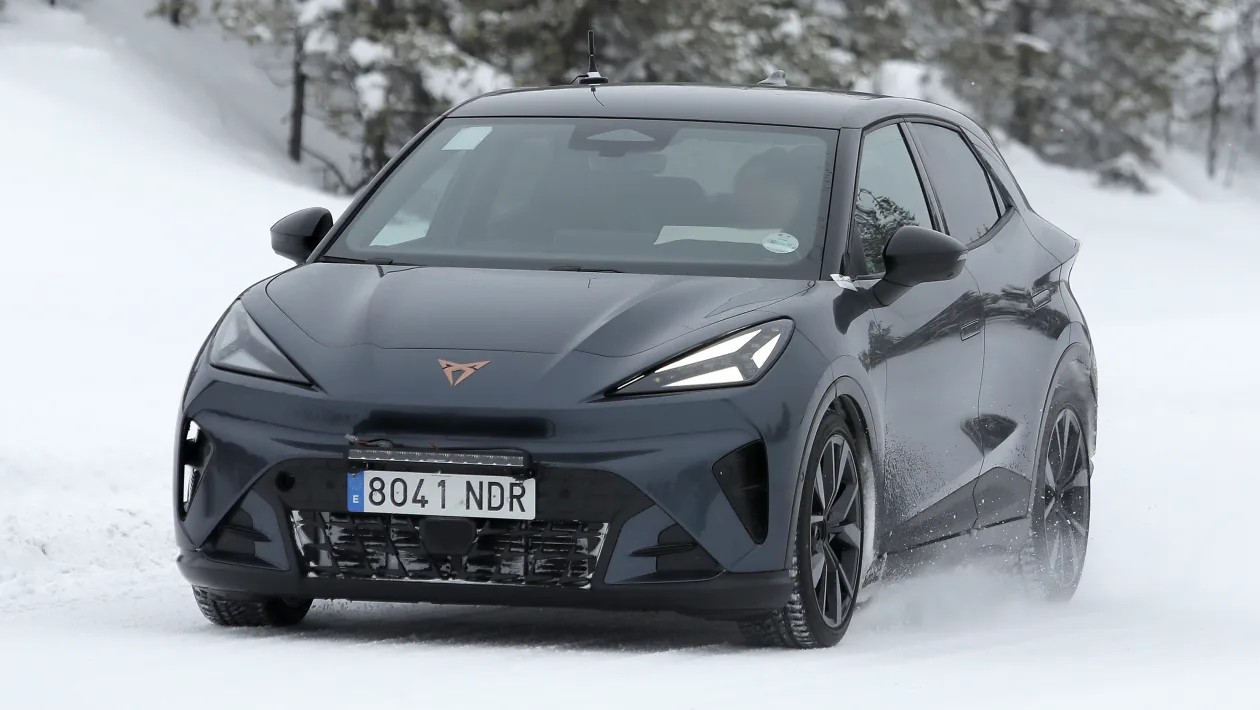
The Cupra Raval, the brand’s first electric supermini, is nearing its official debut. Recent spy shots reveal a production-ready model undergoing final winter testing without any camouflage. This car marks a key step in the Volkswagen Group’s push toward more accessible electric vehicles, signaling a broader trend toward lower-priced EVs across its brands.
Sporty Design, Streamlined Production
The uncamouflaged Raval showcases a sporty aesthetic, closely aligned with the Urban Rebel Concept it’s based on. Angular headlights, aggressive bumpers, and flush door handles confirm its distinct design. Two variants were spotted: a standard model with conventional LED headlights, and a higher-spec version featuring a unique light point arrangement for its daytime running lights.
Both models sport a sculpted tailgate with full-width lighting and an illuminated badge – hallmarks of modern Cupra styling. Despite its aggressive look, the car’s relatively tall ride height is noticeable, considering it’s designed for the B-segment supermini class.
Performance and Battery Tech
Cupra positions the Raval as a sportier alternative to the upcoming Volkswagen ID. Polo. The car will offer a VZ Extreme model with increased power and a limited-slip differential. Both cars will share the same technical components.
The Raval will source its batteries from a new assembly line in Barcelona, Spain, capable of producing up to 300,000 battery packs annually. The initial launch models will feature 208bhp and 223bhp motors, offering a range of up to 280 miles and 249 miles respectively. Later models will include cheaper lithium-iron phosphate (LFP) batteries to reach a target price of around £25,000.
Production and Investment
Spain will serve as the production hub for affordable EVs across VW Group brands, including Cupra, Volkswagen, and Skoda. The new MEB+ chassis will underpin the Raval and ID. Polo, while the Skoda Epiq and VW ID. T-Cross will be assembled separately in northern Spain.
The battery assembly line introduces two key advancements: the use of cheaper LFP cells alongside nickel-manganese-cobalt (NMC) batteries, and a “cell-to-pack” design that reduces weight and cost by eliminating some framework around the cells.
The facility represents a €300 million investment and will operate at a rate of one battery every 45 seconds, with a maximum annual capacity of 300,000 units. The plant will also incorporate solar power and rainwater harvesting to mitigate energy consumption and water usage.
A Turning Point for Electrification
The Cupra Raval’s production is part of a broader €10 billion investment in Spanish electrification by VW and its partners. This move transforms the Martorell factory into a flexible production hub capable of handling electric, hybrid, and combustion models. With a capacity of up to 600,000 cars per year, Martorell represents a quarter of Spain’s total vehicle output.
The Cupra Raval embodies a shift toward more accessible and performance-oriented electric vehicles. Its arrival signals VW Group’s commitment to expanding its EV lineup while streamlining production and reducing costs through innovative battery technology.