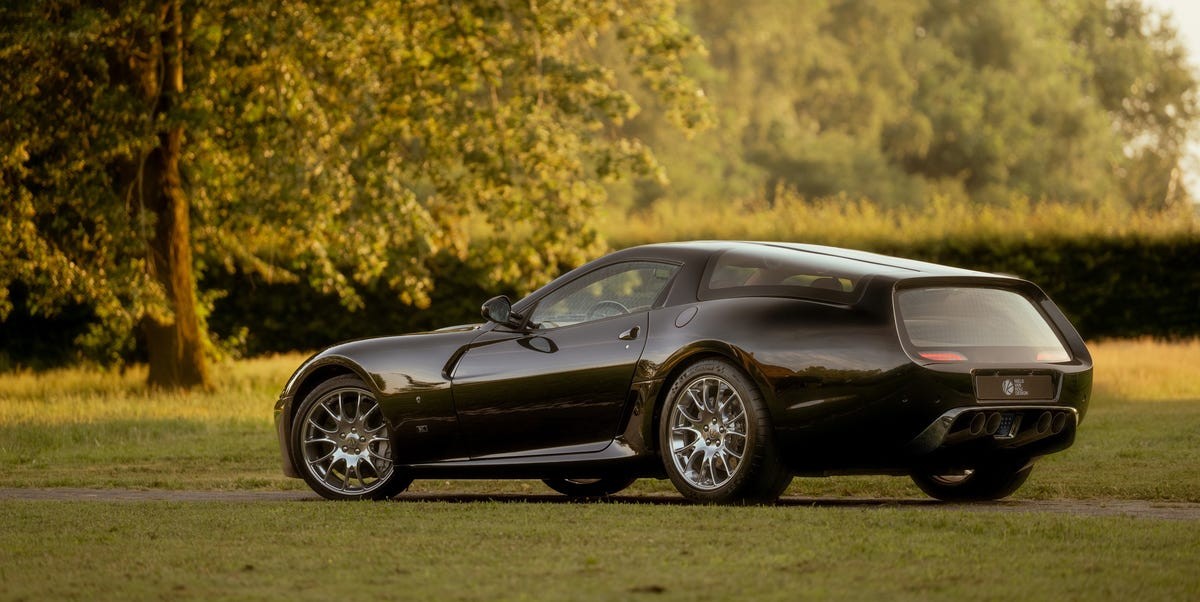
Luigi Chinetti did things his own way. In 1972, the North American Ferrari importer commissioned a wild variation on the Daytona coupe. It wasn’t a race car. It was a wagon. Or rather a Shooting Brake. The original has sat in museums ever since. But now Dutch coachbuilder Niels Van Roij has dusted off that ghost and given it new life.
He calls it the Daytona Shooting Brake Hommage.
It sits on the bones of a Ferrari 599 GTB. Aluminum panels cling to the frame. The doors? Original. The rest? Fresh. The shape is sinuous, aggressive, undeniably fast even when standing still.
Shooting brakes are treacherous creatures. You want the speed of a coupe but the utility of a hatch. Often you get ugliness instead. See the BMW Z4 M Coupe—everyone called it the “Clown Shoe” for a reason. But this isn’t a joke. It falls neatly into the same visual lineage as the Volvo P1800ES. Sleek. Delicate. Right.
“A difficult form to master”
Van Roij knew exactly what he was emulating. The 1972 Chinetti Daytona wasn’t just any car. It was built for a Le Mans champion. A man who understood that cars shouldn’t just drive; they should speak. The modern version copies that voice faithfully. Almost suspiciously so.
Look at the front. Thin headlights stretch across a face that looks suspiciously like the 2005 Chrysler Firepower concept. There is chrome there. Thick of it. An amber graphic stripe sweeps up over the silver Daytona badge. It recalls the orange line on the ’72 model. A wink to the past.
Then the roof rises.
This is the trick. The extended cabin flows into butterfly windows at the rear. They hinge outward. Electronically. Like wings opening on an exposed aluminum skeleton. This gave the original access to a real luggage area. Here it feels like theater. The curvature of the rear haunches is softer, rounder, perhaps more elegant than the sharp angles of 1972.
The end is abrupt. A Kammback slash cuts off the roof. A single pane of glass sits behind it. The taillights hide inside. Below that? Four exhaust tips protruding from the bumper. Loud. Brash.
Inside, the philosophy changes. The driver sits behind a dashboard stripped bare of instruments. Everything moves to the center console. The windshield becomes a tunnel of visibility. This matches the original’s layout. The seats are brown leather. The trim is carbon fiber. Luxury mixed with purpose.
Power comes from the front. Naturally. A 6.0-liter V12 pushes over 600 horsepower to the back wheels through a six-speed automated manual gearbox. No electric motors. No hybrids. Just combustion.
Why does this matter? Because we see shooting brakes every year now. Mercedes makes them. BMW makes them. Even Tesla flirted with the idea. But Van Roij isn’t following a trend. He is following a specific, singular inspiration. This shop also built an homage to the 250 GT Breadvan. They tweaked a Lotus Wraith for Indy car driver Dario Franchitti. This is their lane.
We don’t know the price. Clients for one-offs like this usually buy in whispers anyway. But look at it. Really look. It works. It shouldn’t, maybe. But it does.
Does it need a better name than “Hommage”? Probably. Does it matter? Maybe not. When you drive it past someone in a museum the words might just fade away.