


It isn’t exciting.
That’s the blunt truth of the Mazda 6e. If you are hunting for the driving soul found in an MX-5, look elsewhere. This car is a soft, compliant executive sedan built to keep you isolated from the road. And honestly? That is exactly what a lot of people want now.
The 6e feels like a necessary pivot for Mazda. The MX-30 was a stumble, plagued by short range and high prices that baffled buyers. The 6e cleans up that mess. It is spacious, surprisingly well-priced for what it offers, and looks sharp enough to park outside your office.
What exactly is the Mazda 6e?
Technically, this is a Japanese badge sitting on a Chinese body.
Mazda developed the Mazda 6e alongside Changan Automobile. In China, the car wears the EZ6 badge, sharing its bones with the Changan Deepal L0. The underlying architecture is Changan’s EPA1 platform, not anything derived from the combustion-era Mazda 6.
Why does that matter?
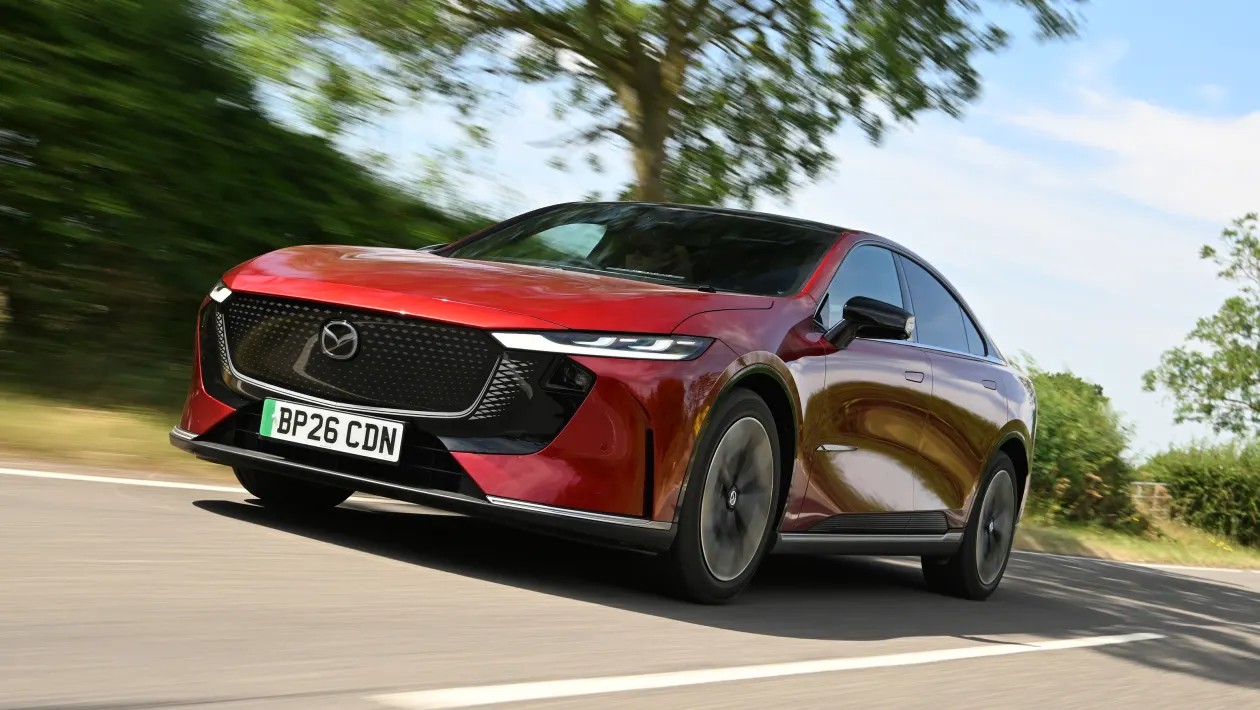
Because the shape is different. Forget the traditional sedan lines of the old 6. The 6e sports a fastback roofline that echoes the BMW i4 and Audi A5 Sportback. It features frameless doors—a nod to the Mazda 323f from decades past—and a hatch-style tailgate. It looks modern. It feels substantial.
Why the Mazda 6e costs less than rivals
Here is where the car gets interesting. The starting price sits just under £40,000.
Compare that to the Tesla Model 3 or the BYD Seal. Mazda is punching above its weight on value. The trim levels are simple. You have the Takumi as the entry point. If you spend an extra £1,000, you get the Takumi Plus. That upgrade brings a different interior color and minor tweaks, but honestly, the base model feels fully equipped already.
“The well-equipped Mazda 6e offers good value, but the Takumi Plus doesn’t add enough to justify the premium for most.”
For company car users, the math is even sweeter. With the Benefit-in-Kind (BIK) tax at 4% for fully electric vehicles, annual running costs drop significantly. You are looking at around £311 per year for standard taxpayers. Even with a high insurance group (44 out of 50), real-world quotes often undercut the Tesla.
Is the Mazda 6e actually fast enough?
It doesn’t drag its feet, but it isn’t a rocket.
There is only one powertrain. A 78kWh battery sends power to a single rear-mounted electric motor. Output sits at 254bhp and 290Nm of torque.
Acceleration to 62mph takes 7.9 seconds. Top speed caps at 109mph.
The Model 3 does this in 6.2s. The Mazda 6e feels adequate. It launches silently. It gathers pace without drama. But it lacks the punch of its American rival. On twisty backroads, the steering offers little feedback. The suspension floats. It prioritizes soaking up bumps over connecting with the asphalt. If you switch to Sport mode, the throttle sharpens and a rear spoiler pops up, but it feels tacked on rather than integral. The car doesn’t care that hard.
Real-world range: Does it panic you?
No. The ghost of the MX-30’s limited range is dead here.
Mazda claims 348 miles on a single charge. Our testing yielded slightly different numbers, but the trend was clear.
We saw consistent estimates of around 303 miles on the display at 100%. Over a mixed route heavy with motorway driving, the car averaged 3.9 miles per kWh. That translates to a realistic range of about 312 miles. It isn’t the efficiency leader (the Model 3 managed 4.4mi/kWH in our test), but 300+ miles is enough to ignore range anxiety on most daily commutes.
Charging is efficient. The onboard system accepts up to 195kW of DC power. A top-up from 30% to 80% takes roughly 15 minutes at a fast charger. You can’t cap the charge at 80% or 90% for long-term health management via a simple menu setting, which is an omission for some enthusiasts. But for a quick coffee-and-charge routine, it works.
Why the interior frustrates (and impresses)
Step inside and the quality shifts up.
Despite its Chinese manufacturing origins, the build feels Japanese. Materials are firm. The fake leather looks genuine. There is brushed silver trim and ambient lighting that makes the cabin feel premium. The Takumi comes in black. The Takumi Plus adds tan accents and suede-like inserts, which brighten the space but might not suit everyone’s taste for cleanliness.
Then you look at the screen.
A massive 14.6-inch touchscreen dominates the dashboard. Nearly everything lives in it. This is where the design falters. Menus are buried. Sub-menus are illogical. Want to change the energy recovery? Touch the screen. Want to adjust climate settings? Touch the lower section of the screen. It is fiddly. It demands your eyes.
One specific annoyance involves the lighting and wiper controls.
They are hidden behind the digital cluster. Or you use a shortcut on the wheel. But here is the rub: the left stalk on the steering wheel only controls screen wash, main beams, and indicators. If you map light controls to a steering wheel button, you use up one of your limited customization slots. It forces you into a workaround.
Dean Gibson, senior test editor, put it simply: “The control layout has a fundamental flaw.”
Boot space and passenger comfort
People fit.
The front seats are plush. Rear passengers have ample knee room and headroom. The frameless doors add a sporty touch when you enter, even if the mechanism feels complex.
The boot tells a different story.
Because the rear motor sits under the luggage area, the floor is raised and the depth is shallow. It isn’t terrible. You can fit a couple of carry-on bags. But it loses to the Tesla and BYD Seal on pure volume. The shape is wide but shallow. Access the rear seats by folding them down? Sure. But expect to shuffle some luggage first.
There is also no rear window wiper. You will clean the rear glass from the inside when it rains. It seems like a small detail until it’s pouring.
Should you buy the Mazda 6e?
If you need a fast EV that dances, pass. The Porsche Taycan or even the standard Tesla Model 3 offer more engagement.
If you want a refined, quiet cruiser that looks like an established luxury brand without the six-figure price tag, listen closely.
The Mazda 6e succeeds by ignoring Mazda’s traditional driving DNA. It is soft. It is comfortable. It is efficient enough. And it is cheap enough to make company car fleets look twice.
The infotainment system needs work. The steering is numb. But for the price? You are getting a lot of car.
It just might not remember to have any fun along the way.


