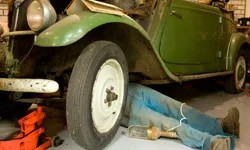
Restoring a classic car is not a hobby for the faint of heart. It is a marathon that consumes hours, thousands of dollars, and likely some of your sanity. You can spend $7.99 on a ’68 Mustang kit in plastic, sand it down, paint it, and feel a warm glow of satisfaction. That is safe. That is easy.
Restoring the actual steel beast is a different animal. The difference between a triumph and a pile of old junk usually comes down to one variable: parts availability. If you cannot find the specific component you need, the project stalls. Here is where you go to find it.
Swap Meets: The Living Library of Restoration
Before you click “Buy It Now” on an online auction, you need to go to the source. Swap meets are traveling circuses of automotive history. Sellers pay for floor space under tents, and you browse hundreds of stalls.
Why go in person? Information.
Online stores sell items. Swap meets sell knowledge. When you are new to the restoration game, standing in line talking to veteran enthusiasts tells you what to avoid and what to prioritize. It is a word-of-mouth ecosystem. You learn which chrome trim sets are fakes, which engine blocks are solid, and who to trust.
Check OldRide.com for upcoming events in your state. Go first. Listen more than you buy. The parts are there, but the context is more valuable.
Brick and Mortar Stores: The Reliable Fallback
Sometimes the internet fails. Sometimes the swap meet is three hours away and you need that specific gasket set by Tuesday.
Brick and mortar stores are the old-school answer. They have stock on shelves. You can hold the part in your hand and check the part number against your manual before you pay. No shipping delays. No “item not as described” disputes.
For specific makes, look for dealerships that still carry restoration lines. For general fasteners, hardware stores often beat specialty shops on price. You are paying for immediacy and physical inspection. If you need a specific OEM part number, call ahead. Do not drive an hour to find out they do not carry it.
Walk into a local shop. Pull out your wallet. Walk out with the part in hand. It feels almost illegal in 2024. The benefit isn’t just the transaction. It’s the conversation. You stand there, point at the shelf, and ask how that specific bolt fits into your chassis. A specialist can read the wear pattern on your old part and suggest the correct replacement before you buy the wrong one.
The catch? Inventory is finite. If they don’t have it, you drive home empty-handed. Make the phone call. Give them the exact make, model, and year. Skip the drive if the answer is no.
There’s an unspoken social contract in these shops. If you spend ten minutes with the counter guy asking for advice, you buy the part from him. Taking that free consultation and then Googling the cheaper price online? Don’t. It burns bridges. Next time you walk in, the help disappears.
Why Online Forums Beat Generic Search Engines
You aren’t the first soul to hunt down a rusted-out carburetor for a 1929 Model A. Thousands of people have walked this path before you. Swap meets and clubs are great, but the digital equivalent is the specialized forum.
Specificity matters. Joining a general “classic car” board to find a part for a 68 Mustang is a waste of time. Search for your exact make and model, then add “forum” to the query. Look for threads dedicated to your specific restoration project. Someone usually has the exact part, or knows who does.
How to not be the person everyone ignores:
- Read the archives first. No one likes a new member who asks a question answered in 2012.
- Offer value. If you know something, share it.
- Ask precise questions. “I need a left-hand door hinge for a 1957 Bel Air” works. “Does anyone have parts?” gets ignored.
- Be humble. These communities run on goodwill, not transactional efficiency.
Why Knock-Off Manufacturers Are a Double-Edged Sword
The aftermarket isn’t just about OEM. Some manufacturers produce “knock-offs.” These are parts designed to look and function like the original, but they aren’t.
Why would anyone buy a knock-off? Price. Often significantly lower.
Why would anyone avoid them? Tolerance. Fit. Longevity. An OEM part is machined to strict specs. A knock-off might be close, but not exact. For a cosmetic piece, who cares. For a suspension component or a transmission gear, that slight variance can mean the difference between a smooth ride and a shredded joint.
Know what you’re buying. Ask the seller about the material. Steel or aluminum? Cast or forged? If the part fails, is there a warranty? Most knock-offs come with minimal to no guarantee. You are betting your time and money on quality control that doesn’t exist.
The Authenticity vs. Reliability Dilemma
There is no single right answer when it comes to sourcing components for a restoration project. It boils down to a fundamental trade-off. Do you prioritize period-correct authenticity, accepting the potential for rust, wear, or fitment issues? Or do you choose a modern reproduction part that functions immediately but might lack historical integrity?
Your decision should hinge on the specific purpose of your build. If you are chasing a show-quality, concours-level finish, a knock-off fender might compromise the value of the vehicle in the long run. You might look at it later and wish you had kept searching for the original. However, if your goal is a reliable weekend driver that looks classic enough for the neighborhood, new imitation parts often offer the best balance of cost, availability, and ease of installation.
Functional versus visual components matter here, too. A reconditioned vintage fender is rarely going to cause a safety issue while driving, provided you verify the make, model, and year match your specific chassis. The risk of driving problems from a visual panel is low compared to the risk of buying a cheap, poorly made reproduction part that cracks or fits poorly.
Before you dive into a project, spend time around other builds. Visit swap meets, check out friends’ garage projects, and observe what actually works. It is easy to mistake high-quality original parts for junk, or vice versa, if you have not spent enough time in the trenches.
Classic Car Magazines: More Than Just Pictures
Print media still holds value for enthusiasts, even in the digital age. Publications like Hot Rod are excellent sources for both inspiration and practical parts sourcing. The more niche the magazine is, the better. A general automotive title is fine for broad ideas, but a publication dedicated to your specific make, model, and year range will provide targeted advice.
These magazines often feature step-by-step guides written by experts. While most have searchable online archives, there is something to be said for holding the physical issue. The tactile experience can spark ideas that scrolling through a website does not. Start your search for specific publications through directory services to find titles that focus on your exact vehicle.
Wrecking Services and Auto Body Shops
Salvage yards and body shops remain one of the most reliable ways to find original, vintage components. These locations often stock parts that are no longer manufactured. While the condition varies, you have a chance to find authentic hardware, trim, or mechanical pieces that fit your car perfectly.
When visiting these shops, inspect everything. Original parts carry a certain weight and texture that modern knock-offs often miss. Bring your specific VIN or model details to help the yard staff locate the correct components. It is a direct, hands-on approach to sourcing that bypasses the uncertainty of online marketplaces.
Wreckers aren’t just scrap heaps. Some operate on a massive scale, running fleets of trucks and managing 100-acre lots where used cars sit next to dismantled shells. Others are smaller operations, a single guy with a truck and a garage full of pristine components. The scale varies wildly, but the goal is the same: separating valuable inventory from metal waste.
Finding the right source requires a phone call. Search for local towing or wrecking services. Ask around. Networking matters more here than almost anything else. A specific bolt or bracket might only exist in one specific yard, held by one specific owner.
How to source classic car parts directly from salvage yards
Salvage yards offer the lowest cost route to classic car parts, provided you do the work yourself. This involves a road trip, work boots, and a tool belt. You are hunting for a diamond in the rough.
The primary rule is specificity. Know exactly what you need before you go. If you don’t know, don’t go. Evaluating a rusting frame requires skill. You need to distinguish between restorable classic material and actual junk. This is not a beginner’s hobby. It is for experts. Inexperienced buyers walk away empty-handed or overpay for unusable metal.
For those ready for the challenge, resources exist. OldRide.com maintains a list of 59 salvage yards across the country that specialize specifically in classic car parts. These are not general scrap yards. They are targeted sources.
Why clubs and organizations are better than random searches
Clubs and organizations act as curated networks. They connect you to enthusiasts who already know where parts are hiding. You aren’t guessing. You are asking people who live and breathe the same marque as you. This shifts the dynamic from scavenging to sourcing.
1: Online Auctions
Bidding wars are a fact of life. You type in “1965 Mustang front bumper” and suddenly you’re staring at a price that climbs faster than your heart rate. Online auction platforms host millions of listings, many of them from private sellers who are clearing out estate finds or half-finished projects. The inventory is deep, but the quality control is nonexistent.
You are buying from a stranger, in a building you’ve never seen, based on photos that might have been taken in 2004.
Is it worth the risk? Sometimes, yes. The price-to-value ratio on these sites can be brutal. If you know what you’re looking for, you can spot a genuine NOS (New Old Stock) part that a retail dealer would mark up by 300%. The trick is knowing the difference between a fresh pull from a low-mile donor and a part that has been sitting in a barn since the Nixon administration.
Check the feedback scores. Look for high-resolution images of the serial numbers. Ask questions. If a seller is reluctant to provide more photos, walk away. The time you save on shipping does not compensate for the cost of learning a hard lesson about counterfeits or corroded internals.
Why eBay wins for budget-conscious buyers
eBay. One word. Two words? Doesn’t matter. It has everything.
Dealers compete with wreckers and individual sellers there. That pressure drives prices down, way below what you’d see at specialty shops.
But you have to be careful.
At a junkyard, you grab a pipe wrench and hit the part. A solid clack means solid metal. You can scrape rust. You can test.
On eBay? You’re blind.
You rely on seller ratings, photos, and descriptions. No sledgehammer allowed.
Trade-off: cheap versus easy.
You decide.
Classic car parts FAQ
Where can I find rare car parts?
Swap meets, brick-and-mortar stores, salvage yards, car clubs, online auctions, online dealers.
What can you do with old car parts?
Restore a real classic. Hundreds of hours. Thousands of dollars. Shouts from the shop.
Where can I sell vintage car parts?
Swap meets. Online auctions like eBay. Peer-to-peer platforms.
Where can I find discontinued auto parts?
Ask yourself what matters.
Knock-off fender? Does it lower the car’s value in your eyes?
Or is “classic look” enough?
If it’s the second, new imitation parts are cheaper, easier, and often indistinguishable from originals to the untrained eye.
How do I find out what my classic car is worth?
Online valuation tools.