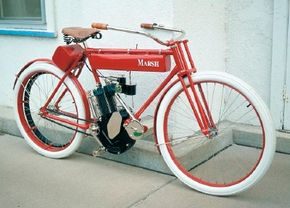
You won’t find many mentions of Marsh Brothers in general automotive history books. They weren’t the Fords or Harley-Davidsons of early industrial America. But if you’re interested in the raw and chaotic beginnings of the two-wheeled revolution, the 1904 Marsh bike is worth mentioning.
The Brockton, Mass.-based brothers were among a growing group of East Coast manufacturers looking to find ways to put wheels under the seats to push them forward. Already in 1899, the company manufactured motorized bicycles. By 1900, they were being produced regularly. Most of these early companies outsourced their hearts. Marsh didn’t. They built their own engines.
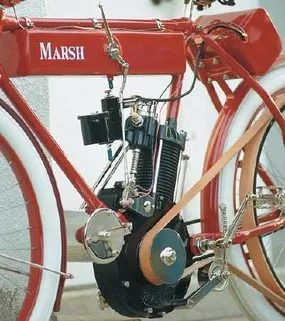
1904 Single cylinder engine
This powerplant was a typical single-cylinder unit of its time, but it had special features that defined its character. It used an atmospheric intake valve. This means that when the piston moves down, the intake opened via suction There is no complicated camshaft timing on the intake side. It’s just about physics and pressure differences.
The exhaust is different. It has a mechanically operated side discharge valve. You had to force the burnt air out.
Ignition is where things get interesting and where things get messy. The 1904 Marsh used a “total loss” ignition system. There is no generator. No dynamo to keep the spark alive while you rode. The battery drains every time you use it. If the battery fails, you’re stuck until you find an external power source to charge it or replace the battery entirely. It wasn’t convenient. It was rugged.
Power and speed characteristics
Early production engines had less than 2 horsepower. That sounds laughable today. It was respectable then. But the brothers were not satisfied with the sluggish commuting machines. In 1902 they built a racing engine. It delivered six horsepower.
The 6 horsepower engine can propel the motorcycle to nearly 60 miles per hour. In 1902, that was blistering. Most riders couldn’t keep up. The engineering challenge wasn’t just getting there. It was staying on the bike when you got there.
Marsh & Metz V-twin era
The motorcycle market is very competitive. Evolution is necessary for survival. In 1905, the Marsh brothers made a deal with Charles Metz. The result was Marsh & Metz (often abbreviated to M.M.).
This partnership brought one of the first V-twin engines available to consumers. It wasn’t just a marketing gimmick. It was a serious mechanical shift. The original V-twin was a 45-degree unit introduced around 1906. Achieves smoother power delivery than single-cylinder models.
But smoothness alone is not enough. Vibration killed early engines. In 1908, Marsh & Metz introduced the 90-degree V-twin model. It is claimed to improve internal balance. Reduces vibration. More reliability at speed. This technological leap is critical for companies looking to shed the “novelty” label and become a serious manufacturer
Why Marsh & Metz Failed
Revolutionary technology costs money. Fierce competition has put a strain on profits. The two-wheeler industry is rapidly consolidating. Small and medium-sized enterprises with abundant financial resources cannot survive.
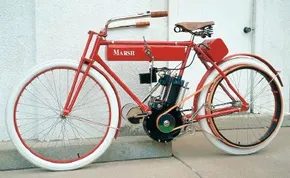
The Early Years of Speed: Marsh and the Pre-War Era
The 1904 Marsh didn’t have much in common with modern motorcycles. It’s practically just an motorized bicycle. Simple construction. Minimal engineering. However, its design is very much in line with the needs of the time, which proves the rapid development of two-wheeled transport.
For enthusiasts at that time, the standard setting was just the beginning. Mod enthusiasts and racers didn’t stop at the stock configuration. They pushed limits. They tuned the engine. They stripped weight. result? A machine that can reach 60 mph.
Considering the circumstances, this number is staggering. We are talking about 1904. The roads are often unpaved. The brakes are rudimentary. There are no safety devices. But the raw speed is there. This showed that if the technology was advanced enough, two-wheeled vehicles could compete in speed with early cars.
Marsh stands out not only for its speed potential, but also for its beauty. This is not some clumsy experimental prototype. It looked good. It handled well. It respects the rider.
This early success laid the foundation for the motorcycle culture that followed. This shows that it’s not just four-wheeled vehicles that require speed. It can be done on two wheels if you put your mind to it.
Classic Motorcycles
Let’s see more about the pedigree. Dig into the archives of early bike culture.
How Motorcycles Work
Let’s understand the mechanics behind the madness. Learn how a simple engine evolved into a powerful machine.
Other Classic Motorcycles
See what else happened before modern times. Discover the forgotten models that shaped the industry.