The internal combustion engine is a miracle of engineering that has been tweaking itself for over a century. Automakers are still squeezing out tiny gains in efficiency and cutting down emissions with every new model year. The result? A machine that is insanely complex but surprisingly reliable.
While other guides break down the fuel pumps, cooling loops, camshafts, turbochargers, and gear ratios, the real magic happens in the ignition system. This is where the fuel and air finally meet their match.
We are going to look at how this system works, starting with the critical concept of spark timing. Then we will dissect the hardware that creates the spark—plugs, coils, distributors. Finally, we will look at the modern shift toward solid-state systems that ditch the distributor entirely.
Mastering Ignition System Timing
Your engine’s ignition system has to sync up perfectly with everything else happening inside the block. The goal is simple: ignite the fuel at the exact millisecond that lets the expanding gases do the most work possible. Fire it too early or too late and you lose power. You also waste gas and pollute more.
When the fuel-air mix burns in the cylinder, the temperature spikes. The liquid fuel turns into exhaust gas. This phase change causes pressure to skyrocket, forcing the piston down.
To get maximum torque, you need to maximize that pressure during the power stroke. Higher pressure means better efficiency. Better efficiency means you stop at the pump less often. The spark timing is the lever that controls all of this.
There is a lag. From the moment the spark jumps to when the fuel-air mix is fully burning and pressure peaks, time passes. If you fire the spark the instant the piston hits the top of its compression stroke, the piston has already started moving down before the pressure maxes out. You’ve missed the window.
To get the most out of every drop of fuel, the spark must fire before the piston reaches the top of the compression stroke. By the time the piston begins its descent into the power stroke, the pressure is already high enough to push it down with force.
The Physics of Work
Let’s look at the math in a cylinder:
- Force equals Pressure times the Area of the piston
- Distance equals the Stroke length
So, work = pressure times piston area times stroke length.
The stroke length and piston area are fixed hardware. You can’t change them without rebuilding the engine. The only variable you have to maximize work is pressure. That brings us back to timing.
You can advance the timing or retard it, depending on what the engine needs.
The time it takes for fuel to burn stays roughly the same. But as the engine RPM climbs, the pistons move faster. This means the spark has to happen earlier. This is spark advance : faster engine speed requires earlier ignition.
But power isn’t the only goal. Sometimes we need to minimize emissions. When you aren’t pushing for max power, you can retard the timing. Moving the spark closer to the top of the compression stroke lowers the maximum cylinder pressure and temperature. Lower temps mean less nitrogen oxide (NOx), which is a regulated pollutant. Retarding timing can also stop engine knock. Many modern cars with knock sensors will do this automatically to protect the engine.
Next up, we look at the components that actually make the spark.
The Spark Plug
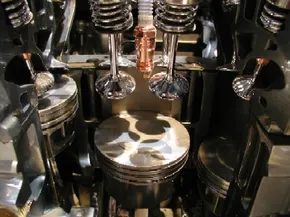

How High Voltage Ignites the Engine Block
Theory is simple. Reality is brutal.
A spark plug forces electricity to arc across a tiny gap. Think lightning. But you need insane pressure to push that arc. The voltage required sits somewhere between 40,000 and 100,000 volts.
That is not a typo.
The plug needs a dedicated, insulated highway for this high-voltage current to travel down to the electrode. Once it hits the gap? It jumps. Then it conducts straight into the engine block to ground out.
But getting there is the hard part.
The component must survive the extreme heat and pressure inside the combustion chamber. It also has to repel deposits from fuel additives. If gunk builds up on the plug, the arc fails. And if the arc fails, the car doesn’t run.

How Heat Ranges and Ceramic Insulators Control Spark Plug Performance
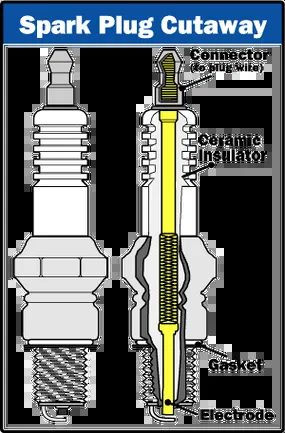
The magic inside a spark plug isn’t just about the gap. It starts with the ceramic insert. This component does the heavy lifting by isolating the high voltage traveling through the electrode. Without it, that electrical charge would arc anywhere it could find a path to ground, likely shorting out before it ever reached the combustion chamber. The goal? A precise spark at the tip where it matters.
But there’s a secondary benefit here. The ceramic also helps burn off deposits. You might assume ceramic is just a barrier, but its thermal properties are part of the cleaning process. Ceramic is a poor conductor of heat. Instead of letting heat escape quickly, it traps it inside the plug during operation. This retained heat is intentional.
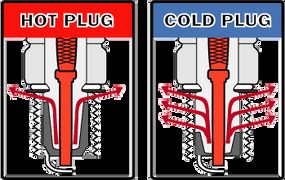
Not all engines need the same thermal strategy. Some require a hot plug. These are designed with a ceramic nose that has a smaller surface area touching the metal shell. Less contact means less heat transfer away from the plug. The result? The plug runs hotter. That extra thermal energy is what burns away carbon buildup and fouling before they can cause misfires.
On the flip side, high-performance or heavily loaded engines often need a cold plug. These feature a ceramic insert with a larger contact area with the metal part. More surface area means heat escapes faster. The plug runs cooler, preventing pre-ignition in situations where extreme heat could destroy the engine.
The choice between hot and cold plugs isn’t about quality; it’s about matching the plug’s heat range to the engine’s specific thermal output.
It comes down to geometry. A smaller insulator nose keeps heat in. A larger one lets it out. Engine designers pick the right balance based on compression ratios, airflow, and cooling capacity. Get it wrong, and you’re either fouling plugs or melting electrodes. The ceramic insert isn’t just an insulator. It’s a thermal regulator.

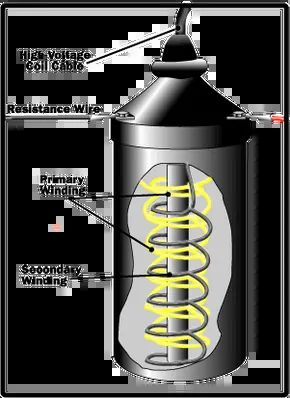

The ignition coil is deceptively simple. It’s just a high-voltage transformer. Inside, you have a primary coil of wire. Wrapped tightly around that is the secondary coil. The difference? The secondary has hundreds of times more turns.
Current flows from the battery, straight into that primary winding. Simple enough.
But the magic happens when you break the circuit.
In older engines, breaker points handle the chopping. Modern systems use solid-state electronics. Either way, the result is the same. The current to the primary coil is cut. Suddenly.
The magnetic field around the primary collapses instantly. That collapsing field rushes through the secondary coil. It induces a current in the secondary winding. A massive current. We’re talking up to 100,000 volts.
That voltage travels out of the coil through a heavily insulated wire. It heads straight for the distributor.
The Distributor’s Role
The distributor does the heavy lifting from there. Its main job is routing that high-voltage pulse to the right cylinder at the exact right moment.
This is handled by the cap and rotor.
The coil connects to the rotor. The rotor spins inside the cap. Inside the cap are metal contacts—one for each cylinder. As the rotor spins, its tip passes each contact.
There’s no physical contact. The high-voltage pulse arcs across the tiny gap between the rotor and the stationary contact. Then it jumps down the spark-plug wire. Finally, it hits the spark plug for the correct cylinder.
This is why you replace the cap and rotor during a tune-up. The constant arcing eats them alive. They wear out. So do the spark-plug wires. Their insulation degrades over time.
Degraded insulation causes mysterious engine problems. Misfires. Rough idling. Things that seem random until you trace the high-voltage path.
In older distributor designs, the bottom half does more than just route power. It also manages the current to the coil itself. The ground side of the coil connects directly to the breaker points. When those points open, the primary circuit breaks. The coil charges. The points close. The cycle repeats.
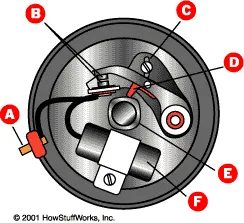

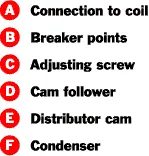

The Mechanical Limitations of Points
Inside the distributor, a simple cam rotates. It pushes against a lever attached to the contact points. When the cam lobe lifts the lever, the points open. This breaks the primary circuit’s ground connection. The magnetic field in the coil collapses instantly. That collapse creates a high-voltage spike sent to the spark plug.
But timing control is where the mechanical system hits a wall. The points rely on either vacuum advance or centrifugal advance. Vacuum advance responds to engine load. Centrifugal advance reacts to engine speed. Both try to optimize spark timing dynamically. But they are crude approximations. They cannot account for every variable an engine faces.
That is why most modern cars abandoned points entirely. Precision matters more than mechanical simplicity.
Why Electronic Ignition Replaced Points
Modern engines use sensors to track piston position with exactness. The data goes straight to the engine control unit (ECU). The ECU doesn’t guess. It calculates the ideal spark timing based on thousands of inputs. Then it triggers a transistor. The transistor opens and closes the circuit to the coil. No moving parts in the distributor to wear out. No points to burn or pitting. Just pure digital control.
This shift wasn’t just about reliability. It was about efficiency. And emissions compliance. Mechanical systems couldn’t keep up with the demands of computer-controlled engines.
The Next Step: Distributorless Ignition
So what comes after the ECU-managed distributor? The next evolution removes the distributor altogether. We’ll look at distributorless ignition systems in the next section.
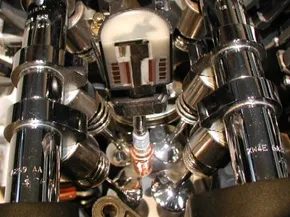
Distributorless ignition systems change the maintenance game. You won’t need a tune-up for the first 100,000 miles. That’s not a marketing claim. It’s a mechanical reality.
The difference comes down to how the spark is created. In older cars, a distributor mechanically routed high-voltage electricity to each cylinder. It failed. It wore out. It caused headaches. Modern systems ditch the distributor entirely. They rely on the engine control unit (ECU) to manage every microsecond of the spark.
How ECU-Controlled Spark Timing Works
The ECU doesn’t just guess. It calculates. It uses data from sensors to determine the exact moment to fire a plug. This is where the coil comes in.
In a coil-on-plug or waste-spark setup, the coil functions similarly to the larger, centrally-located coils of the past, but with a key difference in control. The ECU controls the transistors. These transistors break the ground side of the ignition circuit. When the circuit is broken, the magnetic field in the coil collapses. This collapse generates the high-voltage spark.
This setup gives the ECU total control over spark timing. The computer can adjust timing based on load, temperature, knock sensors, and driving conditions. It’s dynamic. It’s precise.
Why You Can Ignore Tune-Ups
The shift to electronic ignition isn’t just about convenience. It’s about longevity.
There is no distributor to wear out. The mechanical points and condenser are gone. There are no high-voltage spark-plug wires routing electricity across the engine bay. These wires degrade over time, losing insulation and causing misfires. Without them, there’s less to break.
The result is a system that requires almost zero maintenance for the first decade of ownership. You change the plugs when the manufacturer says so, but the ignition system itself? It just works.
The Advantages of Precision
Why does this matter? Two words: efficiency and power.
Older systems had a fixed or mechanically limited timing curve. Modern systems can optimize the burn in real-time. This leads to better fuel economy. It leads to lower emissions. It also squeezes out more power from the same displacement.
Electronic ignition systems have longer lifespans because they lack moving parts. Fewer moving parts mean fewer things to fail. They also offer better fuel economy and less exhaust compared to their breaker-point predecessors.
Understanding the Ignition Landscape
If you’re looking at the history of ignition, it’s not a straight line. There are four main types:
- Conventional breaker-point ignitions.
- High-energy (electronic) ignitions.
- Distributor-less (waste spark) ignition.
- Coil-on-plug ignitions.
The primary purpose of any ignition system remains the same. It creates an electric spark in the engine combustion chamber. This spark ignites the mixture of fuel and air. Without it, the engine is just a heavy block of metal.
An automotive ignition system is what fires up the fuel and air to kickstart your car’s engine. It’s what “turns on” your vehicle and gets it running. The electronic ignition system is simply the evolution of this process, using electronic circuits instead of mechanical triggers to achieve better performance.
More on Engine Mechanics
- How Car Engines Work
- Quiz Corner: Engine Quiz
-
How Fuel Injection Systems Work