Nikola Tesla arrived in New York in 1884. He wasn’t just the father of alternating current. That’s the headline. The reality is messier. He was a prodigy with 272 patents across 25 countries. 112 of those landed in the US alone. You’d expect him to guard his AC grid patents like gold. He didn’t. In 1913, Tesla claimed his most important invention was something else entirely. The Tesla turbine. Also called the boundary layer turbine or flat-disk turbine.
Call it a turbine if you want. It’s technically misleading. Standard turbines use blades. Think fan blades. Water or gas hits them to spin a shaft. The Tesla design has no blades. It uses a stack of smooth, parallel disks. They sit inside a sealed chamber. Fluid enters that chamber. It flows between the disks. The disks turn. The shaft rotates.
This setup can power pumps. It can drive blowers. It can run compressors. Tesla claimed it could even power cars and airplanes. He said it was the simplest rotary engine ever designed. He also said it was the most efficient. If that’s true, the world looks different today. Why isn’t it everywhere? Why didn’t it replace AC as his legacy? Those are the easy questions. The harder ones are about the mechanics. How does it actually work? What made it so innovative?
To answer those, we need to look at the basics. We need to understand the engines that came before. We need to see what problem Tesla was trying to solve. The next section breaks down the engine itself.

Engines have one job. Convert fuel into motion. But before we get to the machine that could have changed everything, we need to look at what came before. And what came before was heavy. Complicated. Prone to breaking.
At the dawn of the 1900s, the world ran on two types of power. Bladed turbines. Piston engines. Both relied on fluids—liquids or gases. Water. Steam. Gasoline vapor. If it flowed, you could put it to work. But the machinery required to harness that flow was a nightmare to build.
Think about a standard piston. It’s a metal cylinder moving up and down inside another cylinder. Simple, right? Wrong. You need valves. Cams. Bearings. Gaskets. Rings. Each part is a potential point of failure. Together, they add weight. They create friction. They waste energy.
Bladed turbines were slightly better at efficiency but worse at reliability. They were massive. Their tolerances were microscopic. If you didn’t machine them perfectly, the blades would crack. Or snap.
The story of how Nikola Tesla solved this starts in a shipyard.
“I remembered the bushels of broken blades that were gathered out of the turbine casings of the first turbine-equipped steamship to cross the ocean, and realized the importance of this [new engine].”
That observation stuck with him. He saw the waste. The fragility. The sheer inefficiency of trying to force high-speed fluid to push against rigid metal fins.
He wanted something smoother. Something that didn’t rely on discrete blades that could shatter.
The Myth of the Inventor
Popular history likes to paint Tesla as the lone genius who dreamed up the bladeless turbine from thin air. That’s not true. The concept existed. A European patent was filed back in 1832.
Tesla didn’t invent the idea. He refined it. He spent nearly a decade tweaking the physics, the materials, and the flow dynamics. He didn’t just patent one machine. He patented three distinct iterations, each building on the last.
Here is the timeline of innovation:
- Patent 1,061,142: “Fluid Propulsion.” Filed October 21, 1909. Granted May 6, 1913. This was the base model. Configured as a pump or compressor.
- Patent 1,061,206: “Turbine.” Filed January 17, 1911. Granted May 6, 1913. Tesla flipped the design. Instead of pushing fluid, he let fluid push the machine.
- Patent 1,329,559: “Valvular Conduit.” Filed February 21, 1916. Granted February 3, 1920. The final piece. Modifications to run the turbine as an internal combustion engine.
The core design remained consistent across all three. The difference was in the application. Pump. Turbine. Engine.
How the Bladeless Design Actually Works
If you’ve never seen a Tesla turbine, you’ll likely imagine a smooth, empty cylinder. It’s closer than you think.
The heart of the machine is a stack of smooth, parallel disks. They spin on a central shaft. No blades. No edges to catch the air. No stress points to crack under pressure.
When you introduce a fluid—steam, gas, water—it hits the surface of these disks. Boundary layer effects take over. The fluid clings to the smooth metal. Viscosity does the heavy lifting. The friction between the fluid and the disk surface drags the disk along.
It’s not magic. It’s fluid dynamics. But it’s efficient.
Why does this matter for a modern enthusiast? Because it eliminates the reciprocating motion that plagues piston engines. No up-and-down movement. No combustion cycles fighting against mechanical inertia. Just rotation.
Tesla proved you could achieve high RPMs without the vibration that tears traditional engines apart. He proved you could run on almost any fluid source. Steam. Combustion gases. Even wind.
But there’s a catch.
The torque curve is weak at low speeds. You need high velocity fluid to get the disks spinning. Once they’re up to speed, the efficiency is undeniable. But getting there? That’s the engineering hurdle.
The parts list is short. Disks. Shafts. Seals. That’s it. Fewer moving parts means less maintenance. Less weight. Higher potential efficiency.
We know the theory. We have the patents. The math checks out.
So why isn’t your car running on one?
The Design Flaws
It wasn’t all smooth sailing. The boundary layer effect, while elegant, is sensitive. If the gap between the disks isn’t perfect, the fluid bypasses the surfaces. Efficiency drops. Power plummets.
Manufacturing those disks required precision that was expensive and difficult in 19
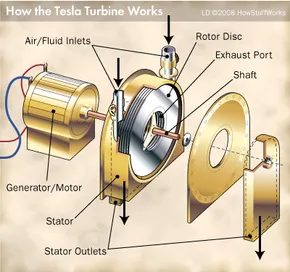

Compared to the mechanical chaos of a piston engine or the hissing complexity of steam machinery, the Tesla turbine is almost insulting in its simplicity. Nikola Tesla himself summed it up in a 1911 New York Herald Tribune interview: “All one needs is some disks mounted on a shaft, spaced a little distance apart and cased so that the fluid can enter at one point and go out at another.”
It sounds like a toy. It isn’t. But the engineering behind it is just as straightforward as the pitch. Let’s strip away the mystery and look at the two core components: the rotor and the stator.
The Rotor Design
Traditional turbines rely on blades. The Tesla turbine discards them entirely. Instead, it uses a stack of smooth disks. Tesla’s patent filings don’t specify an exact count. They simply require a “plurality” of disks with a “suitable diameter.” In practice, Tesla played with variables constantly. The size and number of disks depend entirely on the application.
Each disk has holes drilled around the central shaft. These aren’t just decorative; they are exhaust ports. They allow the working fluid to escape after it has transferred its energy. To keep the fluid moving freely between the disks, metal washers act as spacers.
There’s no rigid rule for washer thickness. However, the gap between disks typically stays between 2 and 3 millimeters. Keep it wider, and you lose efficiency. Keep it tighter, and you risk friction binding.
A threaded nut locks the assembly together on the shaft. The disks are keyed to the shaft, meaning they can’t slip. Rotation transfers directly from disk to shaft. That’s the rotor.
The Stator Housing
The rotor sits inside a cylindrical stator. This is the stationary shell. The interior diameter must be slightly larger than the disks to prevent scraping. It’s a loose fit by design.
Each end of the stator houses a bearing for the shaft. But the magic happens at the inlets. Tesla’s original design featured two inlets. This allowed the turbine to run clockwise or counterclockwise without modification. Nozzles are inserted into these inlets to direct the flow.
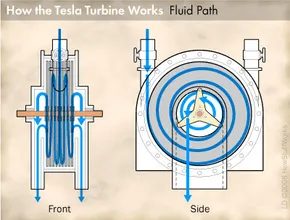
Here is the sequence:
1. High-pressure fluid enters the nozzles.
2. The fluid passes between the rotor disks.
3. The disk stack begins to spin.
4. The fluid exits through the central exhaust ports.
Why It Matters
The beauty of the Tesla turbine lies in its buildability. You don’t need precision machining or exotic alloys. Several mainstream magazines have published plans for DIY versions. In September 1955, Popular Science ran a step-by-step guide to building a blower using nothing but cardboard.
Cardboard. It works.
But how do smooth disks create rotary motion? There are no blades to catch the flow. No edges to lever the fluid. If you’re wondering how a stack of coins can generate torque, that’s the real puzzle. The answer lies in fluid dynamics, not mechanical interception. We’ll break down the physics in the next section.

Fluid energy doesn’t need blades to move metal. It sounds like magic, or maybe a trick of the light. If you spin a smooth disk in water without vanes, logic says nothing should happen. The fluid just slides off.
It doesn’t. The Tesla turbine spins. Fast.
The secret lies in two properties of all fluids: adhesion and viscosity. Adhesion is how dissimilar molecules cling together. Viscosity is resistance to flow. They work together in the Tesla turbine to transfer energy from the fluid to the rotor.
Here’s the mechanics of that transfer.
- Fluid molecules hitting the metal surface slow down. They stick.
- The next layer of molecules bumps into the stuck ones. They slow down too.
- This cascade continues. Each layer drags the one above it.
- Farther from the surface, collisions are fewer. The flow speeds up.
- Viscous forces resist separation. This creates a pulling force.
- That force moves the disk in the direction of the fluid.
This thin interaction zone is the boundary layer. The phenomenon is the boundary layer effect. The propelling fluid follows a spiral path along the disk faces. It accelerates. It exits at a suitable point.
There are no vanes. No buckets. No disruptive forces. The fluid moves in natural paths of least resistance. Velocity and direction change gradually. Tesla claimed 95 percent efficiency. That’s higher than steam turbines of his era.
Reality was different. Production models never matched the theory.
The Boundary Layer: It’s a Real Drag
The boundary layer effect also explains drag on an airplane wing. Air is a fluid. It has adhesive and viscous forces. As air sticks to the wing, it resists forward motion. The aircraft slows down.
Barriers to Tesla Turbine Commercialization
The Tesla turbine never moved from prototype to mass production. Why? The efficiency numbers on paper didn’t translate to the shop floor. Manufacturing tolerances were critical. The gap between disks had to be microscopic. Too wide, and the boundary layer breaks down. Efficiency plummets.
Sealing the high-pressure inlet was another nightmare. Fluid leaks bypassed the disks entirely. No torque transfer. Just wasted energy.
Material fatigue played a role too. Smooth disks spinning at high RPMs suffer from stress fractures. Tesla used steel. Modern composites might help, but the design remains niche.
We see glimpses of it in specialized applications. Heat exchangers. Pumping corrosive fluids where blades would corrode. But for general power generation? The complexity of manufacturing precise gaps outweighs the theoretical benefits.
The Tesla turbine remains a beautiful idea. A testament to fluid dynamics. It just never won the war against the impeller.
The boundary layer is real. It’s a drag. And it kept the Tesla turbine on the shelf.
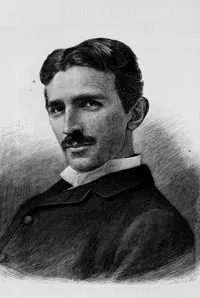

Tesla wasn’t the only one convinced his turbine was a game-changer. The logic held up. Small. Simple to manufacture. One moving part. Reversible. It sounded like the perfect engine for a world ready to move past clunky industrial gear.
Czito, the son of Tesla’s longtime machinist, built the early prototypes. The 1906 model was light. Under 10 pounds. Eight six-inch disks. It spat out 30 horsepower. But it had a fatal flaw. The rotor spun so fast—35,000 rpm—that the metal disks stretched. The gaps closed. Friction spiked. Efficiency dropped.
Tesla kept pushing. A 1910 version doubled the disk diameter to 12 inches. It ran slower at 10,000 rpm but hit 100 horsepower. By 1911, they settled on 9.75-inch disks. Speed dropped further to 9,000 rpm. Power climbed to 110 horsepower. The pattern was clear. Size and speed were at odds with structural integrity.
Then came the big test. Tesla scaled up to a double-unit rig intended for the New York Edison Company’s powerhouse. Each turbine featured 18-inch disks. The setup ran in line on a single base. It hit 9,000 rpm. It generated 200 horsepower.
The engineers watching weren’t impressed. Many were loyal to Edison’s legacy. They misunderstood how torque worked in a disk-based system. They declared it a failure.
Big utility companies had already poured money into bladed turbines. Why switch to a design that seemed to struggle with basic measurements? Investors stayed away.
Tesla tried one last commercial push. He hired Allis-Chalmers in Milwaukee to build three more units. Two had 20 disks, 18 inches wide. They spun at 12,000 and 10,000 rpm. The third was a monster. 15 disks, 60 inches in diameter. It ran at 3,600 rpm and produced 675 horsepower.
Allis-Chalmers engineers got nervous. They watched the disks distort under stress. They doubted the machine could survive prolonged use. The conclusion was bleak. The turbine would eventually fail.
Decades later, replicating Tesla’s numbers proved nearly impossible. Warren Rice, an engineering professor at Arizona State University, built a version that hit 41 percent efficiency. Critics claimed he didn’t follow Tesla’s specs exactly. But Rice’s literature review of 1990s research showed a consistent ceiling. No modern version topped 30 to 40 percent efficiency.
That gap killed widespread adoption. You can’t replace established infrastructure with something that’s merely good enough.
The Office of Naval Research put it bluntly. The Parsons turbine had decades of industry backing it. Unless the Tesla turbine was an order of magnitude superior, it was just throwing money down a rat hole. The industry wasn’t going to turn over easily.
So where does that leave us? The technology didn’t disappear. It just waited. Engineers are circling back to it now. The next section covers why.
The Tesla turbine was never meant to be a standalone product. It was a stepping stone. Nikola Tesla’s real obsession was replacing the piston combustion engine with something that didn’t blow itself apart. He wanted reliability. He wanted efficiency.
Piston engines peaked at around 27 to 28 percent thermal efficiency. That’s it. Most of the fuel just vanishes as heat. Tesla believed his bladeless design could surpass that, even hitting 40 percent. He didn’t just theorize it. He sketched a turbine motorcar on paper. He claimed it could cross the United States on a single tank of gas. The engineering logic held up. The timeline didn’t.
Modern Revival with Advanced Materials
Tesla didn’t live to see his car built. But the technology is waking up.
Phoenix Navigation and Guidance Inc. (PNGinc) in Munising, Michigan, is testing a hybrid that combines Tesla’s disk turbine with a pulse detonation combustor. The results are aggressive. The engine spins at 18,000 rpm. It produces 130 horsepower.
The build is delicate. You have 29 active disks, each 10 inches across. They sit between two tapered end disks. The centrifugal force at that speed tries to tear everything apart. Standard steel won’t cut it. PNGinc uses carbon-fiber, titanium-impregnated plastic, and Kevlar-reinforced disks.
Materials science finally caught up to physics. Had Kevlar existed in 1913, the turbine might have dominated the early 20th century. Instead, it was a machine ahead of its time.
The Mystery of the 1931 Pierce-Arrow
Tesla never drove the turbine car. But he did tinker with electric propulsion decades before Tesla Motors existed.
Accounts from 1931 suggest he converted a Pierce-Arrow. He swapped the gas engine for an 80-horsepower electric motor spinning at 1,800 rpm. Then came the black box.
It was a mysterious cluster of vacuum tubes, wires, and resistors. Two rods protruded from it. Push the rods in, and the car moved. Tesla drove it for a week. Top speed: 90 miles per hour.
The public reaction wasn’t awe. It was fear. People thought he’d tapped into a dangerous natural force. Critics called him insane.
In a fit of rage, Tesla yanked the box out of the car. He took it back to his lab. It vanished.
The working principles of that electric car remain lost history.
Tesla Turbine FAQ
When was the Tesla turbine invented?
It was patented in 1913.
What can a Tesla turbine be used for?
Originally designed for propelling or compressing fluids. It works with compressed air, steam, waste pumps, and even as a centrifugal blood pump.
Will a Tesla turbine work with water?
Yes. It handles water efficiently.
Why is the Tesla turbine not used?
Early tests yielded mixed results. Investors got cold feet. Competitors claimed better efficiency. It got overshadowed by piston technology.
Can a Tesla turbine run a generator?
It can. It’s a viable candidate for backup power sources or standalone generation.
The Next Frontier
For more on Tesla’s electrical innovations, move to the next section.