Hunter S. Thompson once listed five sheets of high-powered blotter acid in his car inventory. Don’t panic. Your vehicle likely has LSD too. Just don’t expect a trip to bat country. You get a limited slip differential instead. It won’t hallucinate. It will just stop you from spinning your wheels in a ditch.
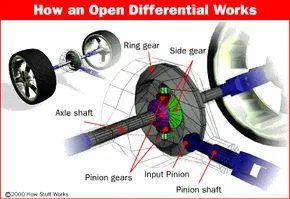
Open differentials are simple. They send equal torque to both wheels on an axle. This works fine until traction fails. Ice. Wet roads. Mud. If one wheel hits a patch of slick pavement, the open diff sends that same minimal torque to the other wheel. The result is predictable. One wheel spins wildly. The other sits still. You are stuck.
Enter the limited slip differential. It keeps the open diff’s benefits during turns. But it fixes the slippage problem. When one tire loses grip, the limited slip differential redirects torque to the wheel with traction. This simple mechanic is the difference between driving away and calling a tow truck. Most systems use clutches or fluid-filled housings to make this happen. You can read more about clutch-type LSDs and viscous couplings elsewhere. They work on single axles or across the driveshaft for all-wheel-drive setups.
Then came the “e”. Electronic. It improved our music. Our mail. Our toothbrushes. Now it manages our differentials.