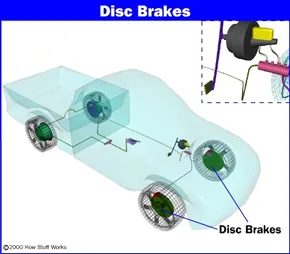
You don’t have to look far to find them. They are hiding behind your wheels, usually bolted to the hub assembly. If you’re curious about stopping power or just want to know why your car squeals, you need to know the layout. Disc brakes are the standard for a reason. They are efficient. They cool better than drums. And they rely on three specific parts working in a chaotic but precise dance.
The Brake Pads
The first piece of the puzzle is the brake pad. You might know them as the friction material. They sit inside the caliper. When you press the pedal, these pads get squeezed against the rotor. That friction slows the wheel down. Without them, you are just spinning metal. Most pads have a metal backing plate and a layer of composite material. Some have shims to reduce noise. Others have wear indicators that scream when the material is gone. It’s a consumable part. You will replace them more often than you think.
The Caliper and Piston
Holding those pads in place is the caliper. It looks like a clamp. Inside that clamp is at least one piston. Some performance cars use four or six. The piston is the muscle. It pushes the pads outward. When hydraulic pressure hits the line, the piston moves. It forces the pads against the spinning rotor. Single-piston calipers slide on pins. Fixed calipers use pistons on both sides. The mechanism changes, but the goal is the same. Apply force. Stop motion.
The Rotor and Hub
The third component is the rotor. It is the large metal disc attached to the wheel hub. The hub rotates with the wheel. The rotor rotates with it. The pads clamp down on the rotor’s surface. This creates the heat and friction needed to halt momentum. Rotors come in different styles. Vented ones have channels between the two faces to dissipate heat. Solid rotors are simpler but cook faster. Drilled and slotted rotors are for track use or aesthetic appeal. They help clear gas and water.
“The main components of a disc brake are the brake pads, the caliper with its piston, and the rotor mounted to the hub.”
Understanding this triad explains almost everything about braking performance. If your pads are thin, you have less friction. If your caliper leaks, you have no pressure. If your rotor is warped, you have vibration. It is a simple system. Until it isn’t.
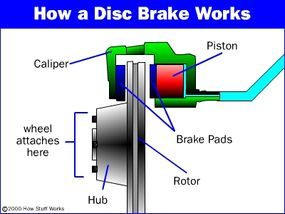
Think of a car’s disc brake as the heavy-duty cousin of your bike’s stopping power. The mechanism is similar. You have a caliper that clamps down on pads. But instead of squeezing a metal rim, those pads bite into a rotating metal disc known as the rotor. The force doesn’t come from a cable here. It travels hydraulically through fluid. Friction between the pad and the spinning disc kills the speed.
A moving vehicle carries kinetic energy. Stopping means removing that energy. You can’t just delete it. The brakes have to do something with it.
Every time you hit the pedal, the system converts motion into heat. This happens because of the friction between the pads and the disc. That heat needs to dissipate quickly. Otherwise, the brakes fade. They lose effectiveness. This is why most car disc brakes are vented.
Why Vented Rotors Matter
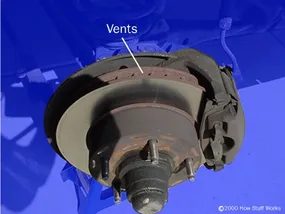
Most modern cars use vented rotors. These aren’t solid slabs of metal. They have an internal structure. Think of it like a sandwich. Two friction surfaces with air channels in between.
When you brake, the heat builds up. The vents allow air to flow through the center of the rotor. This pulls heat away from the friction surface. Without this design, the heat would stay trapped. The pads would glaze over. The braking power would drop significantly.
“Friction between the pads and the disc slows the disc down… Most car disc brakes are vented.”
This isn’t just about stopping. It’s about consistency. A vented rotor maintains performance over repeated stops. It keeps temperatures in a manageable range. If you drive a heavy car or tow a trailer, this design becomes essential. The extra surface area helps shed heat faster.
The Physics of Stopping
Kinetic energy doesn’t vanish. It transforms. The brakes take that forward momentum and turn it into thermal energy. That’s why rotors get hot. Red hot, in some cases.
The hydraulic system amplifies your foot pressure. A small push at the pedal translates to a massive clamp force at the wheel. The caliper squeezes the pads against the rotor. The friction creates drag. The car slows. The energy becomes heat.
This process repeats every time you stop. The better the heat management, the better the brake performance. Vented rotors are a simple but effective solution. They keep the system cool. They keep the car safe.
So the next time you stop, remember the heat. It’s not a side effect. It’s the price of stopping. And the vents are there to pay that bill.
How Vented Brake Discs Actually Cool Your Car
Most people think brakes cool down because air hits the outside of the rotor. That’s half the story. The real magic happens inside the stack.
Between the two friction surfaces of a vented disc brake lies a network of internal passages. These aren’t just random gaps. They are precision-engineered vanes. Think of them like the fins on a radiator, but spinning at 60 mph.
When you hit the pedal, heat builds up. Fast. The rotor spins. The vanes catch the ambient air and pump it from the inner hub out toward the outer edge. This creates a centrifugal fan effect. It doesn’t matter if you’re stationary or moving at speed. The rotation itself drives the airflow.
“The vanes act as an internal pump, actively moving heat away from the friction surface.”
This design solves a specific problem. Solid rotors trap heat. Vented ones bleed it off. In a stop-and-go city commute, that passive cooling is the difference between fade and function.
The vanes are typically made of cast iron, matching the rest of the disc. Their angle and density vary by manufacturer. Some sports cars use more vanes for maximum surface area. Luxury sedans might prioritize quieter operation over raw thermal dump capacity.
It’s not just about having holes. It’s about the geometry. The channels must allow air to enter the center and exit at the rim without creating turbulence that disrupts the flow. If the design is off, you get hot spots. Warping follows.
Most modern passenger cars use this setup as standard. It’s not a luxury feature. It’s a necessity for any vehicle that weighs more than a go-kart and expects to stop safely.
If you look closely at a used rotor, you can sometimes see the shadow of the vanes through the ventilation holes. That’s the proof of the cooling mechanism. A solid rotor would be a thick, dense slab. No internal structure. Just heat storage.
Vented discs turn the rotor into a heat exchanger. They don’t just resist heat. They move it.