Car airbags work. The data doesn’t lie. From 1987 to 2015, frontal airbags saved nearly 45,000 lives in the United States alone, per the National Highway Traffic Safety Administration (NHTSA). They deploy in less than 1/20th of a second. Hard enough to bruise, fast enough to keep your head from hitting the steering column. They do their job when paired with a seatbelt. But what happens when you take the seatbelt out of the equation?
Think about motorcycles. Or horses. Or even just walking down icy stairs.
The NHTSA 2016 report drops a heavy stat: motorcyclists are 28 times more likely to die in a road accident than car passengers. It’s a brutal statistic. Most riders counter with heavy leather, impact-resistant plates, and helmets. It’s standard kit. But there is a newer alternative emerging. Personal airbags.
How Motorcycle Airbags Work
Helite, a French company founded in 2002, has been in this game longer than most. They make airbags for motorcyclists, bicyclists, equestrians, skiers, pilots, and seniors. Their motorcycle system is mechanical in its logic. It uses a lanyard.
The lanyard connects the vest to the bike. If you crash, you separate from the bike. The lanyard disengages. A pin releases. The airbag inflates in less than 1/10th of a second. It stays inflated for 15 to 20 seconds. That window covers the immediate impact and the tumbles that follow.
Equestrian vests work the same way. The lanyard clips to the saddle stirrup strap. You fall? The strap pulls away. The vest inflates. It’s simple physics. Skidbike, a U.S.-based company, uses this same tether approach. It’s reliable because it requires no batteries or complex software to function in the moment of truth.
Sensor-Based Safety Tech
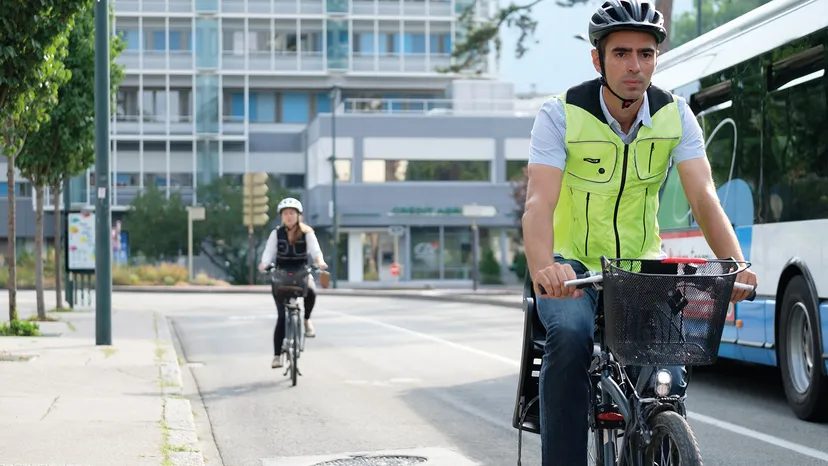
Not all personal airbags rely on physical tethers. Helite’s B’Safe cycling vest takes a different route. It uses sensors.
One sensor lives in the vest. Another mounts under the bike seat. They communicate. They analyze motion and shock. When the data says something is wrong, the vest inflates. It’s proactive rather than reactive to a physical disconnect. The tech was solid enough to win the 2019 French Innovation Award for Road Safety Innovation in the two-wheel assistance category.
This answers the question of how wireless deployment works. It’s about data interpretation, not just mechanical tension.
Senior Safety and Hip Protection
The tech isn’t just for high-speed risks. There’s a product called Hip’Safe designed for seniors. The goal is specific: prevent hip fractures.
The belt contains sensors that detect dangerous or unusual movement. If a fall is initiated, the sensors trigger the airbag. It deploys over the hips. It inflates fast. It is fully expanded before the wearer hits the floor or an obstacle.
These systems fill a gap that car airbags can’t reach. They are modular. They move with you. The automotive world solved the crash problem with fixed points. The personal safety world is solving it with adaptive gear.
It works until it doesn’t. Or until the battery dies. Or until the sensor misreads a bump for a fall. The technology is there. The adoption is slower. But the potential to reduce fatality rates for two-wheelers and vulnerable pedestrians is undeniable.
You just have to trust the vest to do its job when the pavement comes up to meet you.