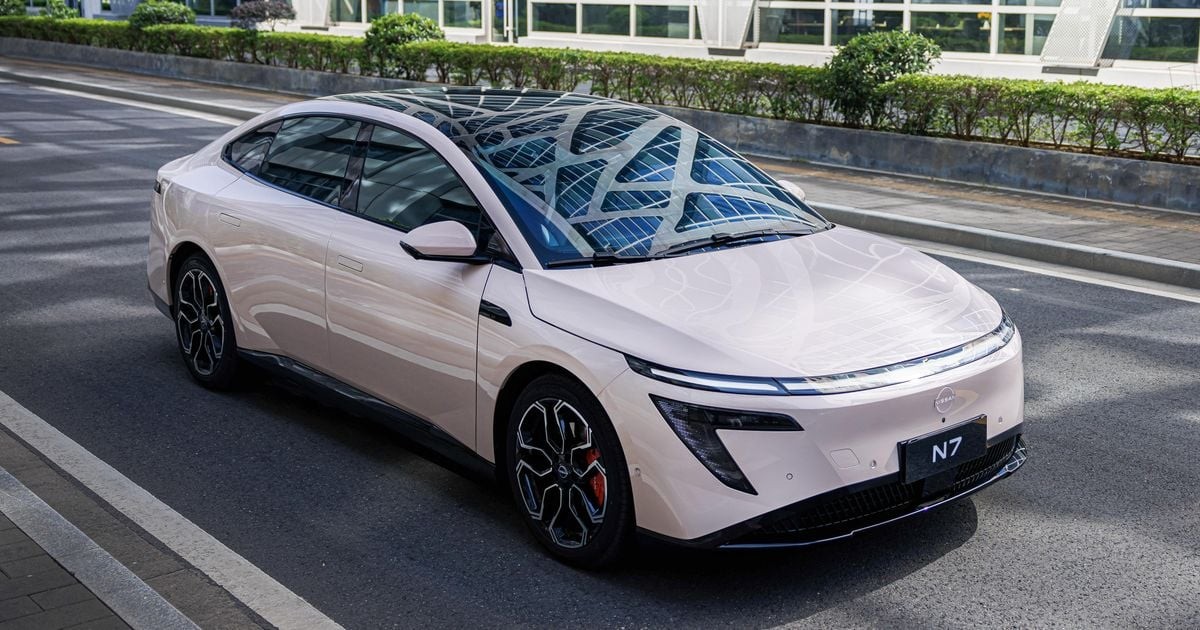
For years, Nissan’s presence in the sedan market felt like a fading memory. Once a powerhouse with legendary names like the Skyline, Maxima, and Altima, the brand has largely pivoted away from the traditional “three-box” body style. However, a new chapter is emerging with the Nissan N7 —a fully electric, large-scale sedan that signals a high-tech comeback for the brand.
Developed through a strategic partnership between Nissan and Dongfeng in China, the N7 is not just another electric vehicle; it is a sophisticated attempt to reclaim premium territory in the EV era.
A Cabin Built on High-Tech Comfort
Stepping inside the N7, the design language moves away from the stark, ultra-minimalism popularized by Tesla. Instead, the interior offers a more textured, premium atmosphere.
The cabin features a sophisticated blend of materials, including ribbed door cards and soft-touch surfaces on the dashboard. One of the most striking innovations is the AI-driven seating technology. These seats use integrated airbags to adjust the base and backrest, physically contouring themselves to the occupant’s skeletal structure for optimized comfort.
Key Interior Highlights:
– Spaciousness: A flat floor and generous legroom make the rear cabin suitable for large adults.
– Practicality: Despite its sleek profile, the boot offers a respectable 484 litres of space.
– Tech Integration: A massive 15.6-inch infotainment touchscreen serves as the command center, powered by a Qualcomm Snapdragon processor.
– User Interface: While the system is feature-rich, the reliance on a touchscreen for climate and fan controls may be a hurdle for drivers who prefer tactile, physical buttons.
Driving Dynamics: More Than Just an Urban Commuter
While many entry-level EVs feel like glorified golf carts, the N7 delivers a more substantial driving experience. During recent testing in Japan, the N7 felt less like a rival to the Tesla Model 3 and more like a competitor for the much larger Tesla Model S.
Despite being front-wheel drive, the N7 displays a “grounded confidence.” The suspension is composed, and the steering provides accurate weighting and response. While it isn’t a high-performance sports car, the power delivery is urgent and measured, providing a smooth, premium feel rather than erratic bursts of speed.
Efficiency is also a major talking point. Thanks to an incredibly aerodynamic drag coefficient of 0.208Cd, the N7 is remarkably efficient, with energy consumption figures sitting between 12.4 and 13.4kWh/100km (CLTC cycle).
Safety and Intelligence
Nissan is leaning heavily into autonomous driving technology through a partnership with Momenta, a leader in the Chinese tech market. The N7 comes equipped with Level 2 autonomy features, including:
– ProPilot Tech: Assists with lane-keeping, distance management, and speed control on highways.
– Emergency Systems: Autonomous emergency braking and a comprehensive surround-view camera system.
– Smart Parking: Semi-autonomous parking capabilities to simplify urban driving.
The Big Question: Will it reach Australia?
The N7’s arrival in international markets remains unconfirmed, but there is a strong strategic reason for it to land in Australia. As the federal government implements New Vehicle Efficiency Standards (NVES), Nissan will need a fleet of low-emission vehicles to avoid heavy penalties.
The challenge for Nissan will be pricing. The N7 is larger than a Tesla Model 3, meaning it may carry a higher price tag. To succeed, Nissan may need to follow the “Mazda blueprint”—utilizing partnerships to offer high-spec, long-range EVs at competitive price points (similar to how Mazda has approached the electric sedan segment via Deepal).
The Bottom Line: The Nissan N7 is a sophisticated, well-engineered return to the sedan format. If Nissan can balance its premium tech with an accessible price point, it could become a formidable player in the growing electric sedan market.