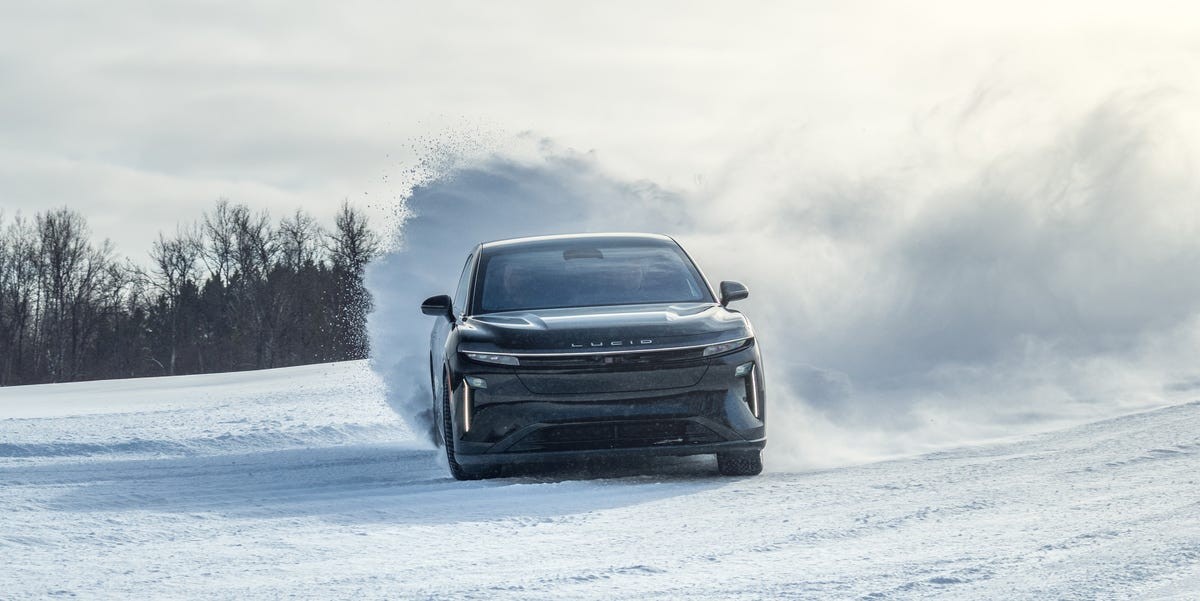
Electric vehicles (EVs) are often overlooked when discussing winter driving, but new testing confirms their surprising dominance over traditional internal combustion engine (ICE) cars on snow and ice. Lucid Motors recently demonstrated this advantage at its winter testing facility in Baudette, Minnesota, where engineers put the latest models through rigorous conditions. The key isn’t just horsepower – it’s how quickly an EV can react to changing traction.
The Speed Advantage
Unlike ICE vehicles, EVs respond almost instantly to loss of grip. Lucid’s latest systems, integrated with Bosch stability control, adjust motor output 1000 times per second to counteract slipping tires. This is significantly faster than traditional braking systems, which take up to 20 times longer to engage. The speed comes from compact motors with integrated differentials, minimizing inertia and maximizing responsiveness.
How Lucid’s System Works
Lucid vehicles use a six-axis accelerometer to monitor every movement: acceleration, pitch, roll, and yaw. Combined with wheel speed and driver inputs, the system determines when and how to intervene. In the Gravity SUV, the car first adjusts motor output before engaging brakes, leveraging each system’s strengths. The Air Sapphire, with two rear motors, takes this further: in “Track” mode it provides rally-like balance, while “Off” mode induces controlled drifts.
Real-World Performance
At TRC Minnesota’s demanding test courses, the 1234-horsepower Air Sapphire proved exceptional. Drivers were able to precisely control the heavy sedan through tight corners and blind crests, even with rear tires spinning wildly. The vehicle’s responsiveness felt natural, reacting to driver input without hesitation. In comparison, a Tesla Model Y felt restrictive, while a Porsche Macan 4S slid irrecoverably, underscoring Lucid’s advantage in extreme conditions.
Oversteer and Regenerative Braking
Even advanced systems have limits. Rear-drive EVs, including some Lucid models, can experience oversteer due to regenerative braking on ice. The solution? Disable regenerative braking when driving in slippery conditions.
The Future of EV Winter Performance
Lucid’s testing reveals how EVs can outperform ICE cars in winter. The speed of motor control, combined with precise sensors and intelligent software, creates a safer, more controllable driving experience. As Lucid engineers consider four-motor systems, the potential for even greater control in extreme conditions becomes clear. The future of winter driving may well be electric.