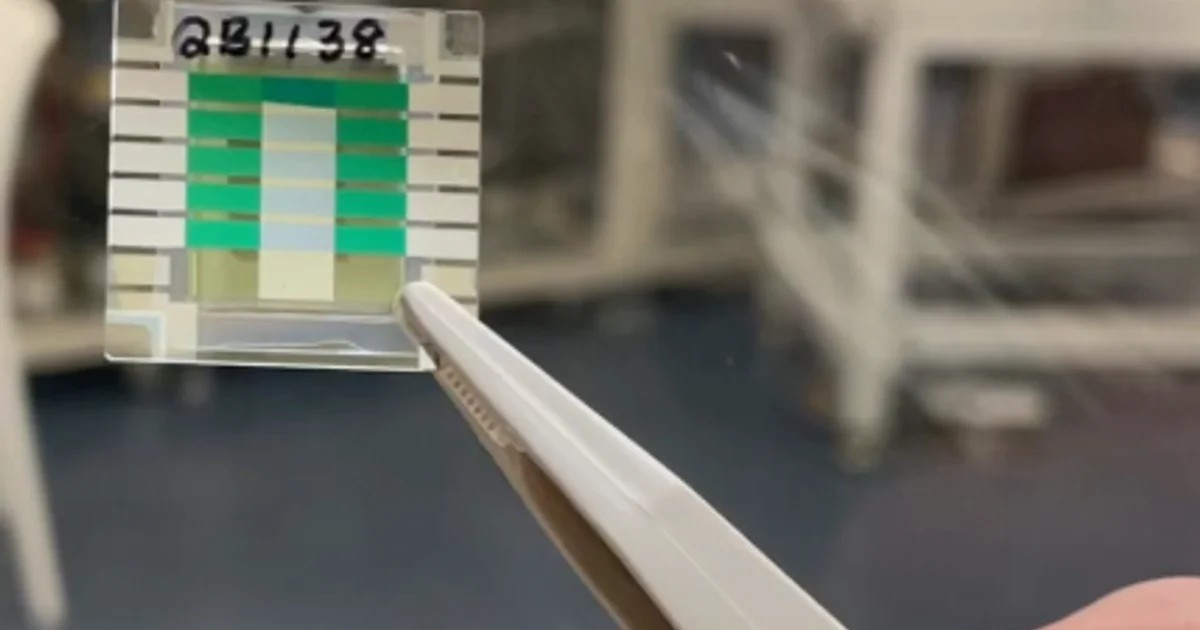
Australian researchers have achieved a breakthrough in energy storage, developing the world’s first functional quantum battery prototype. This innovation, led by the Commonwealth Scientific and Industrial Research Organisation (CSIRO) in collaboration with RMIT University and the University of Melbourne, could revolutionize electric vehicle (EV) charging and wireless power transfer.
The Quantum Advantage: Faster Charging Through Physics
Traditional batteries rely on chemical reactions for energy storage. Quantum batteries, however, harness quantum mechanics – specifically superposition and entanglement – to achieve fundamentally different charging dynamics. The CSIRO team’s prototype uses a layered organic microcavity charged wirelessly via laser, demonstrating the potential for cable-free energy transfer.
A key finding is that these batteries charge faster as their size increases, a counterintuitive property not observed in conventional batteries. This could be critical for scaling the technology to power larger systems like EVs. As Dr. James Quach, CSIRO’s quantum science leader, explains, “Our findings confirm a fundamental quantum effect that’s completely counterintuitive: quantum batteries charge faster as they get larger. Today’s batteries don’t function like that.”
Implications for Electric Vehicles and Beyond
The development of commercially viable quantum batteries would address a major barrier to EV adoption: charging time. Current fast-charging infrastructure still requires significant wait times (20-40 minutes), while home charging can take hours. Quantum batteries, in theory, could charge an EV in seconds or even faster than refueling a gasoline vehicle.
Beyond speed, the technology opens the door to long-distance wireless charging. This would eliminate the need for extensive physical charging infrastructure, making EV ownership more convenient and expanding access to electric mobility.
Hurdles Remain, But Progress is Significant
While the prototype demonstrates promising energy retention (six orders of magnitude longer than charging duration), practical implementation faces challenges. The primary hurdle is extending the energy storage time. According to Dr. Quach, “The next step for quantum batteries right now is extending their energy storage time. If we can overcome that hurdle, we’d be that bit closer to commercially viable quantum batteries.”
The CSIRO is actively seeking industry partnerships to accelerate development. Even if full commercialization is years away, the research confirms theoretical predictions and offers a glimpse into a future where energy storage is faster, more efficient, and wireless.
“Our proof-of-concept device showcases rapid, scalable charging and energy storage at room temperature, laying the groundwork for next-gen energy solutions.” – Dr. James Quach
This breakthrough has the potential to redefine the automotive industry, not just by improving charging speeds but by fundamentally changing how vehicles are powered. The future of energy storage may be quantum, and Australia is leading the charge.