The first Stutz to roll off the line didn’t just start; it raced. It finished eleventh in the inaugural Indianapolis 500, a result that earned the brand the slogan “The Car That Made Good in a Day.” That single race day didn’t just put Stutz on the map. It sparked the creation of the Bearcat. Alongside the Mercer Raceabout, these machines introduced America to the concept of the sports car. Big engines. Minimal bodywork. Built to be taken to the track by anyone with a wrench and a death wish.
Privateers and factory teams alike found success. Stutz traded heavily on this sporting reputation. It never mass-produced vehicles. In its first full year, 1912, output was a modest 266 units. By 1917, that number had climbed to 2,207. That was high volume for a boutique manufacturer.
By the early 1920s, Stutz was engineering its own powerplants. The lineup included a massive 361-cubic-inch side-valve four producing 88 brake horsepower. There was also an overhead-valve six rated at 75 bhp. In 1924, the six was bored out to 268 cid and tuned to 80 bhp for the Speedway Six. Fours were killed off the next year.
Design lagged behind engineering. By the mid-1920s, Stutz looked old-fashioned. Enter Frederick E. Moskovics. The European-born executive took over the presidency in 1925. He did for Stutz what Zora Arkus-Duntov would later do for Corvette. He injected European influence into the chassis. The result was better handling and sharper performance.
Moskovics introduced the “Safety Stutz” in 1926. These were the first models to carry Stutz’s new eight-cylinder engine. It was a European-inspired inline unit. Single overhead camshaft. Dual ignition with two plugs per cylinder. Stutz dubbed it the “Vertical Eight.”
The Vertical Eight became the heart of every Stutz from 1926 through the final 1935 models.
The engine debuted at 289 cid and 92 bhp. It grew quickly. By 1927, displacement hit 298.6 cid. Two years later, it was 322 cid and 113 bhp. Advertised horsepower stalled there. Real output likely pushed toward 140 bhp by decade’s end.
The Blackhawk line existed as an exception. Running from 1929 to 1930, it was a companion model. It used an L-head Continental eight or an overhead-cam Stutz six. At a base price of $2,395, it was “cheap” for Stutz. Sales remained weak. Just under 1,600 units moved. After 1930, its chassis became the base for the brand’s lowest-cost models.
Stutz dominated AAA stock car racing in 1927. It also gave Bentley trouble at Le Mans in 1928. The brand’s racing image was bulletproof. Chassis engineering, however, became stagnant. After 1929, the wheelbases remained fixed. Three sizes persisted until the end: 134.5 inches, 145 inches, and 127.5 inches.
Supercharging was attempted. Stutz mounted a massive blower low, ahead of the radiator. Driven directly from the crankshaft, it lifted output to 143 bhp. It was noisy. Carburetion was a nightmare. But it worked.
Moskovics left in 1929. The best was still to come. Stutz followed Duesenberg’s lead in 1931. A new 32-valve twincam cylinder head arrived. It sacrificed the dual ignition of the “SV16” single-valve engine. Breathing improved drastically. The new “DV32” dual-valve engine produced 161 bhp at 3,900 rpm.
Sales in the 1930s were brutal. Luxury buyers vanished with the economy. Stutz pivoted to truck manufacturing. The cars remained beautiful, but the market had moved on.

The Desperation of the LA and LAA Models
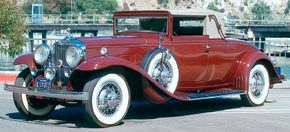
Stutz was desperate to arrest the slide in sales as the Depression deepened. Their solution was the LA for 1931 and the LAA for 1932-33. These were revived six-cylinder models, essentially downgraded versions of their earlier prestige machines. They offered standard coupes and sedans alongside five semi-custom body styles. The price tags reflected the grim economic reality. The LA started at $1995. The LAA dropped even lower, hitting just $1620.
Under the hood sat a stripped-down version of the Vertical Eight. It was the same 241.5-cid single-cam engine found in the departed Blackhawk, but with two cylinders removed. The output was a meager 85 bhp. Yet the car weighed better than 4300 pounds. The math was brutal. These cars lacked speed. They also failed to sell. Stutz abandoned the LA and LAA line after 1933.
A No-Compromise Luxury Trap
With the mid-range models gone, Stutz was left with only high-priced vehicles. This reflected a no-compromise approach to sporty performance, but it made the company an odd fit in the luxury market. Even standard-body models cost upward of $3000 to $4000. That was a fortune during the hard times.
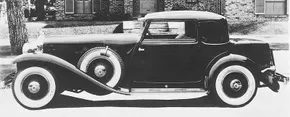
For those who could afford it, thirty custom styles were available. They were built on SV16 and DV32 chassis by top-tier crafters. Names like LeBaron, Fleetwood, Rollston, Weymann, Brunn, Waterhouse, and Derham added their flair.
Stutz had been using Weymann bodies since 1928. These were not steel shells. They were actually padded leatherette. Weymann bodies were light. They were strong. They were elastic and quiet. Compared to steel, they soaked up more noise and road shock. Repairs were easier too. They didn’t last as long as steel, however. Crash protection was minimal. Many buyers disliked the dull, pebbled finish. The looks were considered dowdy.
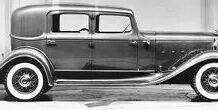
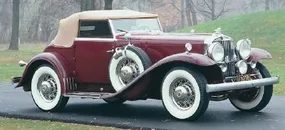
Still, Stutz offered the well-proportioned Weymann Monte Carlo. It was a five-passenger four-door “sport” sedan. By 1932, this Monte Carlo was available in aluminum on the DV32 platform. The price was $4895 complete. Stutz also brought back the Bearcat name. They released a boattailed speedster and a short chassis convertible coupe. Both were guaranteed to exceed 100 mph.
The DV32 and the Financial Bleed
The DV32 debuted in chassis form at the New York Auto Show in the winter of 1930-31. Prices were announced in late March 1931. Production began by July. At roughly the same time, Stutz reported net earnings of just $20,000 on gross sales of $100,000. It was pitifully meager. But it was preferable to the red ink that had flowed since 1929.
Further changes came for the 1932 SVs and DVs. The four-speed gearbox was replaced by a rugged three-speed synchronized unit. Freewheeling became a new option. The hot-air manifold was swapped for a hot-water heating system. An oil cooler was added. A new trunk rack and dust valance were installed at the rear. Bodies were dropped in a curving line to cover the frame. Single-bar bumpers replaced the previous double-bar design.
Despite these updates, the financial picture worsened. Stutz lost $315,000 in fiscal 1932. The company continued to stumble with the same basic lineup of SV16s and DV32s. They were little changed. It is hardly surprising then that Stutz lost another half-million dollars in 1933. Another quarter-million vanished in 1934. These sums weren’t huge by modern standards. They were draining Stutz’s already meager resources fast.

The Pak-Age-Car Gambit
Desperation drives some of the most interesting machinery. Stutz management tried to claw back into solvency by pivoting to small delivery trucks, dubbed the Pak-Age-Car. George H. Freers took the helm as chief engineer for this last-ditch effort. By summer 1936, they rolled out the first 28 of a 340-vehicle order.
It was a noble attempt. It was also insufficient.
The small truck line couldn’t generate enough cash flow to save the brand. Stutz declared bankruptcy in April 1937. The numbers on paper looked promising on the surface. Assets stood at $1.2 million. Liabilities were just $733,000. But liquidity is what keeps a car company alive, not theoretical balance sheets. Stutz couldn’t meet its immediate debts.
Creditors fought over how to reorganize. No deal was struck. A federal judge stepped in during April 1938, ordering the liquidation of every remaining asset. The process dragged through the summer.
So, what happened to the machinery and the name?
Production of the Pak-Age-Car didn’t stop dead; it just moved. The factory lines shifted to Auburn’s idle facility in Connersville. Diamond T Truck Company took over the sales and service network, keeping the utility vehicles in the hands of buyers even as the Stutz legend faded into history.
More on defunct American cars
- AMC
- Duesenberg
- Oldsmobile
- Plymouth
- Studebaker
- Tucker