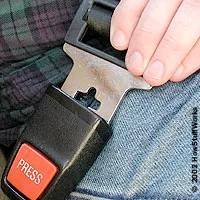
The mechanism is deceptively straightforward. A seat belt stops you from becoming a human projectile through the windshield or a fleshy battering ram against the dashboard. But to understand why that happens, you have to look at the invisible force dragging you forward when the car stops dead.
It’s inertia.
Inertia is just the stubborn tendency of any object to keep doing what it’s already doing. If it’s moving, it wants to keep moving. If it’s still, it wants to stay still. It is resistance to change in speed or direction.
Drive at 50 mph. Inertia wants that car—and everything inside it—to maintain that 50 mph trajectory. The engine fights air resistance and tire friction to keep the pace up. But you? You are along for the ride. Your body accelerates until it matches the vehicle’s speed. You feel like one unit with the machine.
Then comes the impact.
Hit a telephone pole? The pole exerts force on the car. The car stops. Your body does not.
Because your inertia is independent of the chassis, you continue forward at 50 mph. Without a restraint system, you don’t stop gently. You slam into the steering wheel. You fly through the glass. The dashboard or the road itself becomes the thing that stops you.
And that is where the physics turns lethal.
When you hit a windshield with your head, the deceleration is instantaneous. The glass is hard. The force is concentrated on your skull. That is a recipe for catastrophic injury or death. The stopping power is too sharp, too focused, and too fast for the human body to survive comfortably.
A seat belt changes the equation.
It distributes the stopping force across the stronger, more durable parts of your frame—the pelvis and the rib cage. It also manages the timeline. Instead of stopping you in a fraction of a second against a hard surface, the belt stretches and locks, extending the duration of the deceleration.
That extra time matters.
By spreading the load and slowing the stop, the belt prevents your internal organs from slamming against your skeleton. It keeps you from turning into a ragdoll. You survive the crash because the physics work in your favor rather than against you.
But how exactly does the belt lock under that load? And what happens if the restraint fails? The mechanics of that survival are just as critical as the concept itself.