The Cupra Raval just got cheaper. Not slightly. Significantly.
Thanks to the Government’s Electric Car Grant, most trims now shave £1,500 off the sticker price. It is a bold move by SEAT’s hot division to undercut its main rival, the sporty little Renault 5. Base prices now sit just under £24,005. Cheap? Yes. Affordable? Depending on the battery you pick, maybe.
Here is the catch.
You only get this discount if you opt for the larger battery pack. The smaller 37kWh pack, available on the entry-level Origin model, does not qualify for this specific grant tier. It feels like a bit of a sleight of hand, but hey. The Renault 5 gets a better deal actually—grab the comfort range and you snag a full £3,750 Band 1 discount. Even the tiny 40kWh Renault qualifies for the Band 2 chunk.
Cupra says “focus on performance,” which usually translates to “buy the expensive bits.”
The hardware reality
The Raval sits on the MEB Entry+ platform. That means it is siblings with the upcoming Skoda Epiq, the VW ID. Polo, and the larger Cupra Born. It shares bones, but Cupra tries to hide that with a sport chassis. They dropped the ride height 15mm. Widened the track by 10mm. Tuned the suspension to be twitchy. They call it “emotional.” I call it marketing, but it is genuinely quite agile for a hatchback this size.
“Engineered to deliver a dynamic experience” is the official line, but does it feel like a hot hatch or just a loud EV?
The Origin model—the cheap one without the big discount—is powered by a 114bhp motor. Range? About 186 miles. That lags the base Kia EV2. It likely trails the Skoda Epiq too, which is taller and probably aerodynamically smoother, or perhaps worse? The chemistry is LFP, so it is cheap to make, durable, and heavy.
Step up to the V1 or V2 trims and things get interesting. You can spec the smaller battery with a peppier 134bhp setup. Or you can jump to the 52kWh NMC battery. That bumps you into the discount zone. Prices land around £28,500 for a V1 with the big pack.
That gives you 279 miles of range. It eclipses the Renault 5. It eats it. But it costs more than the discounted Renault equivalent if you compare like-for-like efficiency.
The V2 with the large battery costs nearly £31,000. There is also a “Launch Edition” of the V2 at the same price, adding safety kit and Dinamica seats. Then there are the VZ models. The £33,500 VZ and £35,000 Extreme. They are locked to the large battery. Power jumps to 222bhp. Zero to 62mph takes 6.8 seconds. That is almost as quick as an Alpine A110 Gts+.
What does that cost? Your patience in traffic, mostly.
Looks, screens, and weird lights
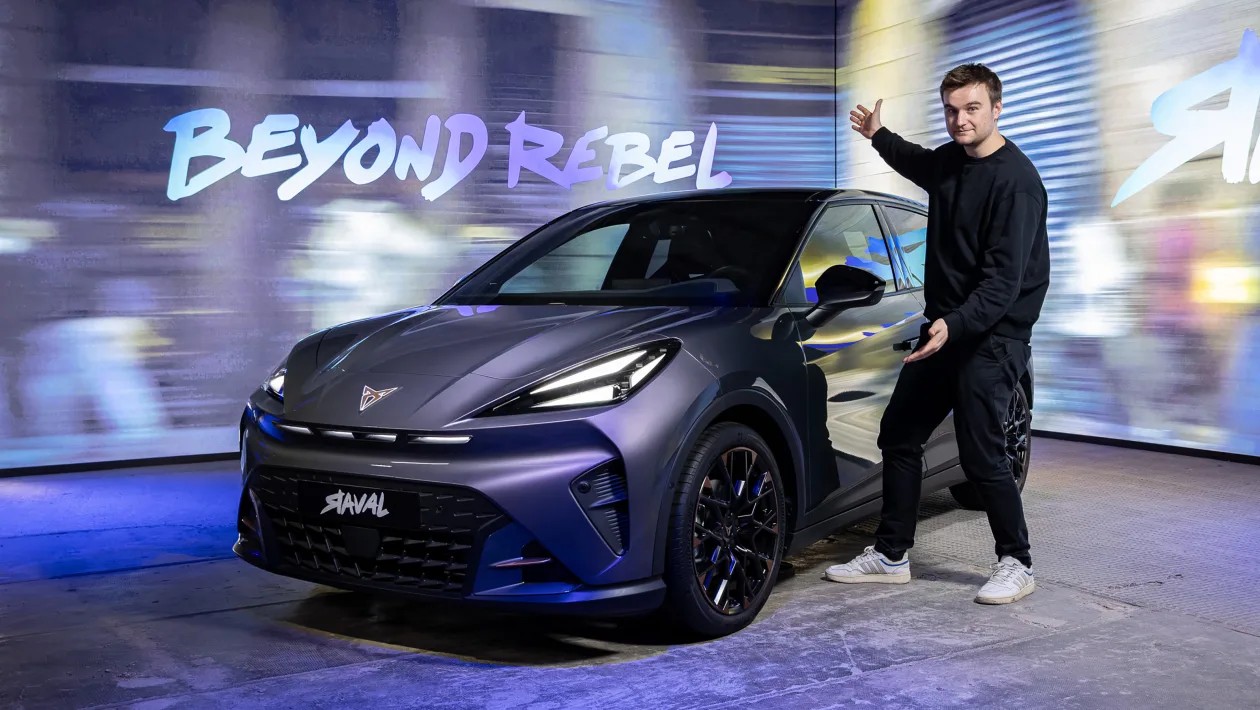
It looks exactly like the concept. Cupra rarely changes its look from show to road anymore, which saves money on development but looks like laziness. Or genius, if you ask a fan. Three triangular LED lights up front. Sharp creases. A “shark nose” grille. Flush door handles to reduce drag. The drag coefficient is the best in the Cupra family, which is something, even if the body is small.
Inside, it is a VW Group party. The 12.9 infotainment screen is ripped straight from the Born. The 10-inch driver display is ubiquitous across the brand. But there is a new OS. Google-based. It runs smoother, hopefully, than the laggy mess found in some older Taycans, oh wait, wrong brand. Still, it runs better.
There are no touch-sensitive buttons for the climate control. Just sliders. Thank god. We thought VW had gone completely mad with those gesture controls, but physical dials have returned. Sort of. The audio sliders are still touch-based. Why? Because they forgot to retool? Or just bad planning.
The interior has copper accents. It has ambient lighting. But the standout feature? Projector lights in the doors.
Seriously. Lights in the doors that shine onto the armrest area. They project patterns. Dynamic, configurable patterns. No car before the Raval has had this. It feels less like a driving aid and more like a nightclub entrance.
Is there room for stuff?
Here is a surprise. The electric motor sits under the hood. Not in the rear. This means the boot is deeper.
430 liters with the floor up. That is 45 liters more than the larger Cupra Born. The Born is 278mm longer than the Raval, yet it loses the luggage war. Weird engineering compromises work in favor here.
If you add the 12-speaker sound system, the sub-woofer eats 20 liters of that space. You do the math.
Charging speeds are respectable for the segment. The small 37kWh charger peaks at 90kW. Ten to 80% in 27 minutes. The large 52kWh pack goes to 130kW. Same increment in 23 minutes. Fast enough for a motorway stop, not fast enough to make you forget you are plugging in.
The final say?
The Raval is trying to be many things at once. It is an urban commuter. A hot hatch wannabe. A tech demonstrator for Google and ambient lighting projections. It succeeds in some, fails in others. The price cut makes it competitive. The range anxiety with the small pack remains real. The design is polarizing—some love the aggression, others see it as a over-caffeinated toy car.
We have driven it. We like it, mostly. The E-Launch sequence feels gimmicky the first time, boring the tenth. But the handling is sharp. It turns in where you point it, rather than where the GPS suggests.
So you can buy one. Through a dealer somewhere. Prices vary. Grants shift.
Will it steal sales from the Renault? Probably not from the cheap ones, but it will steal attention. Which, in 2024, might be more valuable than money.
Who is actually going to park in the same spot twice just to show off their door-lights? 🚗💡