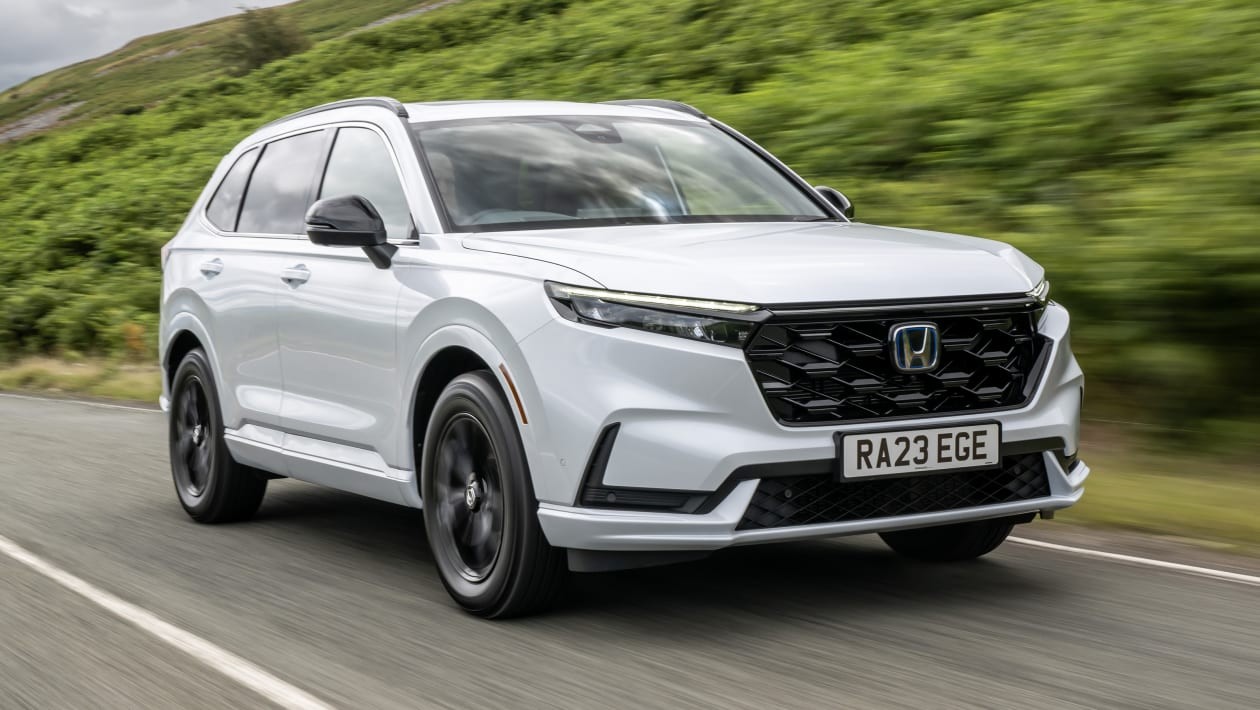
The sixth-generation Honda CR-V has grown significantly, stretching to over 4.7 meters in length. It has officially outgrown its “Compact Runabout” roots to become a substantial, spacious family SUV. While it excels in smoothness and safety, it faces stiff competition from more affordable rivals and highly efficient hybrids.
Driving Dynamics: Smoothness Over Speed
The CR-V is built around a 2.0-litre Atkinson cycle engine paired with an electric motor. Whether you choose the standard hybrid (e:HEV ) or the plug-in hybrid (PHEV ), the driving experience is characterized by seamless, electric-like progress.
- The Hybrid Experience: The engine primarily acts as a generator to power electric motors, resulting in a jerk-free ride. Unlike some competitors that use e-CVT systems which can cause high engine revs during acceleration, the Honda system feels more refined and predictable at motorway speeds.
- Performance: With 181bhp, the CR-V is “adequate” rather than thrilling. It hits 0-62mph in roughly 9.4 seconds—fine for family duties, but it won’t compete with the rapid acceleration of a Tesla Model Y.
- Handling & Ride: The steering is accurate and easy to use, from city streets to winding B-roads. However, the car can feel “nose-heavy” in corners, and the ride can become fidgety over rougher surfaces, even with standard 18-inch wheels.
Practicality and Technology
For families, the CR-V offers a high level of standard safety technology. Notably, Honda’s driver assistance systems tend to be less intrusive than those found on many rival vehicles.
“The camera feed from the left-hand door mirror… proved to be a real boon when executing lane-changes on a busy autobahn in wet or gloomy conditions.” — Chris Rosamond
Key Tech Highlights:
* Adjustable Regenerative Braking: Unlike many hybrids, you can adjust the deceleration rate using steering-wheel paddles, allowing for more control without constant brake pedal use.
* Safety Interface: A minor drawback is the software layout; certain safety warnings, like the speed limit alert, must be disabled via the touchscreen before you start driving, as the menu locks once the car is in motion.
Efficiency and Running Costs
This is where the CR-V faces its toughest challenges. While it is a capable vehicle, its efficiency and pricing are heavily influenced by its hybrid architecture.
The Hybrid Divide
- e:HEV (Standard Hybrid): Offers a respectable 42.8mpg, though its efficiency is slightly hampered by the fact that all models come with four-wheel drive.
- e:PHEV (Plug-in Hybrid): Boasts an impressive official electric range of 49.1 miles. However, in real-world mixed driving, users should expect closer to 49mpg once the battery is depleted.
The Cost Factor
The CR-V sits in a premium price bracket, starting at over £48,000. This puts it in direct competition with luxury SUV options.
- Tax Advantages: The PHEV model is a strong choice for company car drivers due to its low 18g/km CO2 emissions, placing it in a favorable tax band.
- The Downsides: The CR-V is more expensive to insure than many rivals (sitting in insurance groups 34–37) and is subject to a luxury car tax surcharge because its initial price exceeds £40,000. Furthermore, the hybrid battery configuration means the UK range lacks a seven-seat option, which is available in petrol versions in other markets.
Verdict
The Honda CR-V is a polished, high-quality SUV that prioritates smoothness and safety, making it an excellent choice for relaxed family motoring. However, its high entry price, higher insurance costs, and the presence of more efficient, cheaper rivals like the Toyota RAV4 mean buyers must weigh its premium feel against its long-term running costs.
Summary: A refined and spacious family SUV that excels in smoothness and safety, but carries a premium price tag and higher running costs than some of its more efficient competitors.