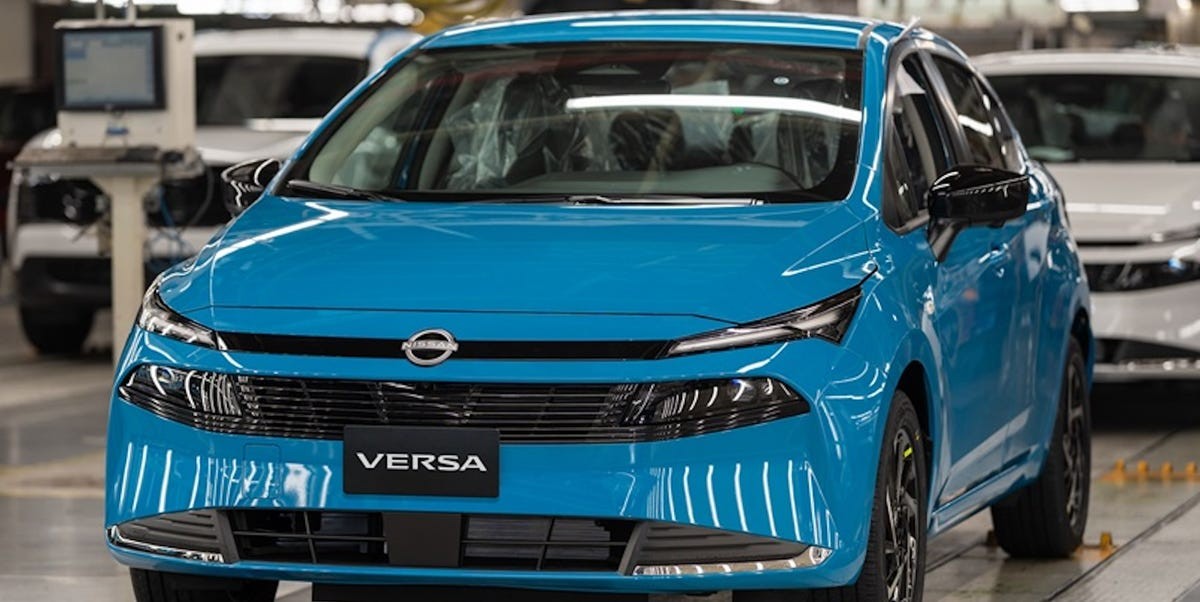
Nissan has unveiled the next-generation Versa, but only for the Mexican market. The 2026 model has begun production in Mexico, where the subcompact sedan remains a top seller – unlike in the United States, where it was discontinued after the 2025 model year. This split strategy highlights how Nissan prioritizes different markets based on consumer demand and profitability.
Design Overhaul for a Key Market
The new Versa features a redesigned front end inspired by Nissan’s Murano SUV. The styling includes thin LED daytime running lights and a wider grille, giving it a more modern look. The overall body shape appears similar to the outgoing Versa, suggesting Nissan is refining rather than completely reinventing a winning formula. The change reflects a broader trend of automakers tailoring designs to specific regional preferences.
Mexico’s Dominance vs. U.S. Decline
The Versa was the bestselling car in Mexico in 2025, with over 1 million units sold since 2011. This success contrasts sharply with its decline in the U.S., where the model struggled to maintain sales despite a late surge. Nissan’s decision to discontinue the Versa in the U.S. reflects the shifting preferences towards SUVs and trucks in that market.
Powertrain and Production
The new Versa is being produced at Nissan’s Aguascalientes A1 plant in Mexico, which has now built over 8 million vehicles. While specific technical details haven’t been released, the powertrain is expected to carry over from the previous model, likely a 1.6-liter four-cylinder engine with either a five-speed manual or CVT transmission. This approach suggests Nissan is minimizing costs while keeping the Versa competitive in the Mexican market.
Implications for U.S. Consumers
The Versa’s absence from the U.S. leaves a gap in the sub-$20,000 new car segment. This highlights a broader trend: automakers are increasingly focusing on higher-margin vehicles, leaving fewer affordable options for budget-conscious consumers. The decision to keep the Versa alive in Mexico while axing it in the U.S. underscores how global market dynamics influence product availability.
Nissan’s decision to prioritize Mexico over the U.S. for the Versa demonstrates a clear strategy: focus on where the demand is strongest. This leaves U.S. buyers with fewer options in the low-price segment, but it ensures Nissan can continue selling a popular model in a profitable market.