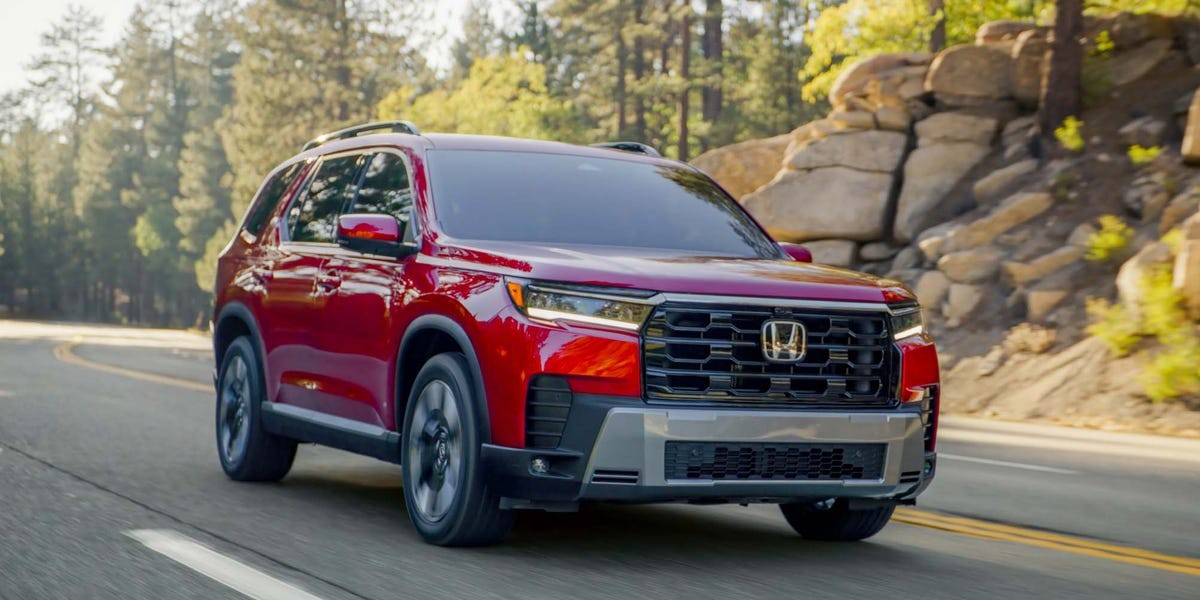
Honda’s 2026 Pilot receives modest updates to stay relevant in the crowded three-row SUV segment, but falls short of substantial improvements. While competitors are rapidly adopting new platforms, hybrid powertrains, and bolder designs, the Pilot maintains its core identity as a dependable, if unremarkable, family vehicle.
Exterior and Interior Refinements
The most visible changes come in the form of a larger front grille and more pronounced skid plate, echoing the design language of the redesigned 2026 Passport. However, the Pilot’s overall appearance remains closer to a minivan than a rugged off-roader. Interior updates include upgraded materials – such as contrasting stitching and faux-suede upholstery – in higher trims, though it still doesn’t match the luxury of rivals like the Hyundai Palisade or Mazda CX-90.
The Pilot prioritizes practicality with spacious third-row seating, ample storage, and power-folding rear seats for easy access or cargo expansion.
Performance and Efficiency
Under the hood, the Pilot continues with its unchanged 3.5-liter V-6 engine, producing 285 horsepower and 262 lb-ft of torque. The engine performs adequately but feels strained when accelerating or overtaking, especially given the vehicle’s size.
Fuel economy remains a weak point, with EPA ratings of 20-22 mpg combined – lagging behind more efficient competitors. Honda has confirmed plans for a hybrid powertrain in future models, a move that is increasingly critical as electrification gains traction in the segment.
Pricing and Value
The base Sport trim now includes a larger 12.3-inch touchscreen and power liftgate, but the price has increased significantly to $43,690. Higher trims, such as the TrailSport and Touring, also see price increases commensurate with their added features. The top-tier Elite model now exceeds $50,000 with standard all-wheel drive.
The Bottom Line
The 2026 Honda Pilot’s updates are sufficient to maintain its position in the midpack of three-row SUVs. However, the lack of significant mechanical improvements, especially in efficiency, means it risks falling further behind as competitors continue to innovate. Honda will need to make more substantial changes to the next-generation Pilot if it aims to lead the segment.