


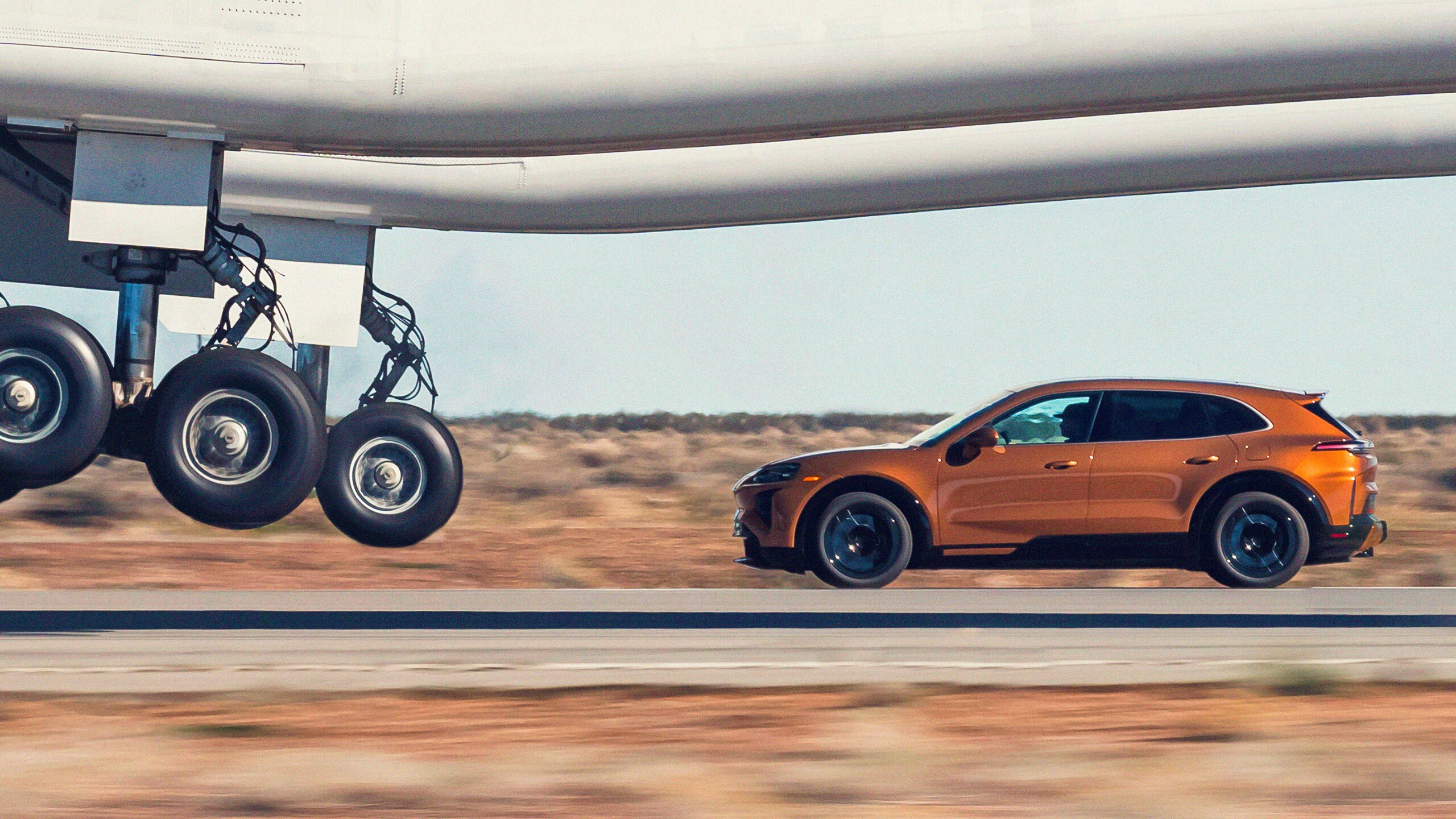
The world’s largest aircraft has a wingspan that would make most of us dizzy. But at the Mojave Air and Space Port, it wasn’t the plane that was the real test of engineering. It was a Porsche.
Specifically, the new Cayenne Electric.
The brand wanted fanfare. Real fanfare. So it paired the 5,831-pound SUV with Roc—the Rutan Stratolaunch with the widest wingspan on Earth. We’re not talking about some nimble fighter jet here. Roc is a twin-fuselage behemoth. It weighs 1.3 million pounds loaded. And it has six jet engines.
Patrick Long drove the Porsche.
His job was simple. Terrifying. Stay directly under the plane’s nose gear as it took off.
No, really. Underneath it.
If he got too far back, the jet blast would flip the SUV into next week. That blast is 340,500 pounds of thrust. Enough to turn a car into confetti. If he got too far forward, he’d smash into the landing gear before takeoff. Precision was the only option.
Long didn’t have to catch the plane. He just had to keep pace with it until it left the ground.
The Cayenne Turbo Electric pushed to 167 mph. That’s 269 km/h. The plane lifted off just feet above his roof. Long stayed centered. Rock solid.
Why The Cayenne Electric Was The Only Choice
You might ask: why an SUV for this?
Weight. Mass. Momentum.
A lighter sports car would have danced in the slipstream. Or worse, been tossed by the turbulence. The Cayenne Electric tips the scales at 2,645 kg. That heft acted as an anchor.
But power mattered too.
The flagship Cayaine Electric produces 1,138 horsepower and 1,106 pound-feet of torque. That’s 1,500 Newton-meters of instant, electric muscle. It didn’t just accelerate; it held its line.
“It was probably one of the most focused moments of my life.”
— Patrick Long, Porsche driver
Long said they started slow. Minimal power. Just enough to track the Roc. Then, as the plane hit runway speed, he let go. The battery was fully charged. The data was there. He knew the car could hold its position no matter how wild the airflow got.
The Risks Of Riding A Jet’s Wake
This isn’t just about going fast. It’s about surviving the physics of flight.
The gap between the ground and a plane’s landing gear is narrow. The turbulence generated by six engines spinning at max thrust is violent. At 167 mph, air doesn’t move out of the way easily. It crashes.
Long had to thread the needle.
The positioning required absolute symmetry between Roc’s two fuselages. There’s no margin for error. One inch off-center and the stunt turns into a recovery mission. The team relied on precise data modeling before a single tire hit the tarmac. They believed in the numbers. Then they trusted their hands to follow them.
Why This Stunt Matters (Beyond The Spectacle)
It sounds like a publicity stunt. And it is.
But it’s also a demonstration of electric vehicle stability.
Traditional ICE vehicles might struggle with the sudden drag and lift changes near a massive aircraft. Electric drivetrains respond instantly. No turbo lag. No gear shifts. Just torque, controlled by software, applied exactly where needed.
The Cayenne remained stable not just because of its weight, but because of its control systems. It adjusted power millisecond by millisecond to counteract the shifting air pressure around it.
That’s a level of real-time adjustment that combustion engines can’t match without complex mechanical intervention.
So, did the Porsche beat the plane?
No. It followed it.
But staying alive while doing it? That’s the win.
Roc soared. Long stayed grounded. And for a few seconds, in the dust and noise of the Mojave, they shared the same space.
Not a race. A synchronization.
And if you’ve never seen a car drive under a giant plane, you’re missing something rare.


