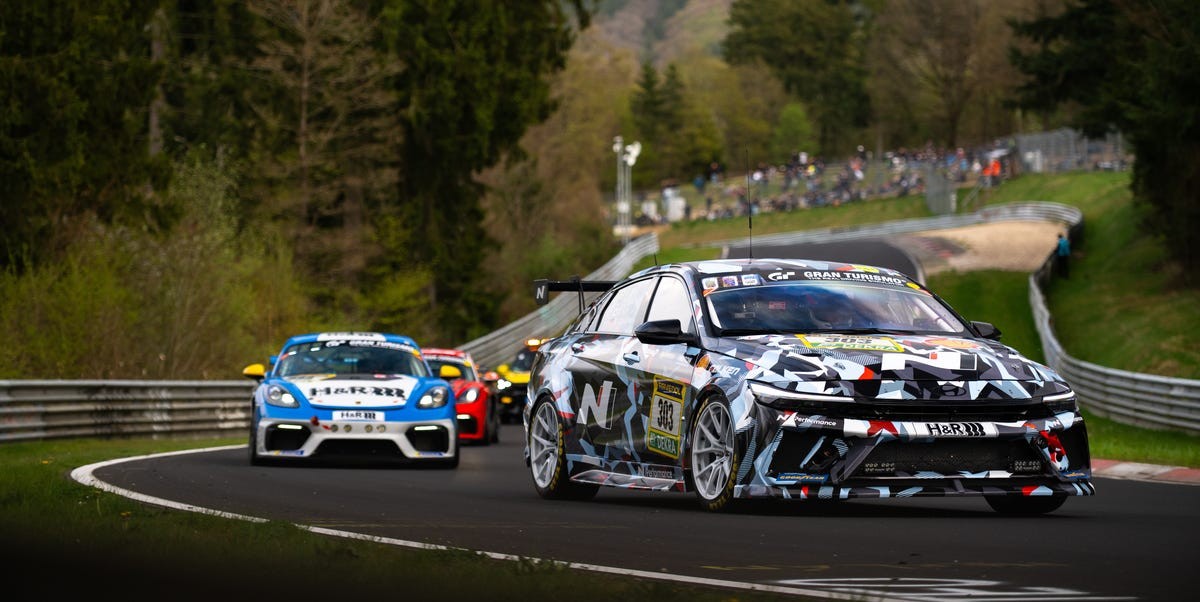
Hyundai is preparing to push its next generation of high-performance engines to the limit. For the 11th consecutive year, the Korean automaker will participate in the prestigious 24 Hours of Nürburgring, using the grueling endurance race as a real-world laboratory for its upcoming N-branded vehicles.
Proving Durability Through Extreme Stress
While the average consumer will never drive a performance sedan for 24 hours straight, the extreme conditions of the Nürburgring provide a unique testing ground. Racing at high revolutions for an entire day and night subjects mechanical components to levels of heat, friction, and stress that standard road testing simply cannot replicate.
For this year’s event, Hyundai will field the Elantra N1 RP in the SP4T class. These race cars will be powered by a pre-production prototype engine intended for future customer models, such as the next iteration of the Elantra N sedan.
What We Know About the New Engine
Although Hyundai has kept specific technical specifications under wraps, the company has provided several key indicators of what enthusiasts can expect from this new powertrain:
- Increased Power: The prototype is expected to outperform the current 2.0-liter turbocharged four-cylinder engine.
- Enhanced Responsiveness: The engine is being tuned for better throttle response and sharper performance.
- Regulatory Compliance: Despite the focus on power, the new engine is being engineered to meet strict modern emissions standards.
A Proven Development Strategy
This approach is not a new experiment for Hyundai; rather, it is a continuation of a successful development philosophy. By using racing as a “stress test,” the company ensures that the high-performance engines found in showroom models are both reliable and durable.
A notable precedent occurred in 2016, when Hyundai tested a prototype version of its turbocharged 2.0-liter Theta engine at the Nürburgring. That testing directly paved the way for the successful launch of the i30N hot hatch in 2018. By repeating this cycle, Hyundai aims to bridge the gap between professional motorsport technology and street-legal performance.
The 24-hour race serves a dual purpose: it is both a rigorous mechanical validation tool and a public demonstration of the N brand’s engineering reliability.
Conclusion
By testing prototype engines in the world’s most demanding endurance race, Hyundai is ensuring that its future high-performance vehicles deliver both increased power and long-term reliability. This strategy reinforces the brand’s commitment to bringing track-tested technology to the consumer market.