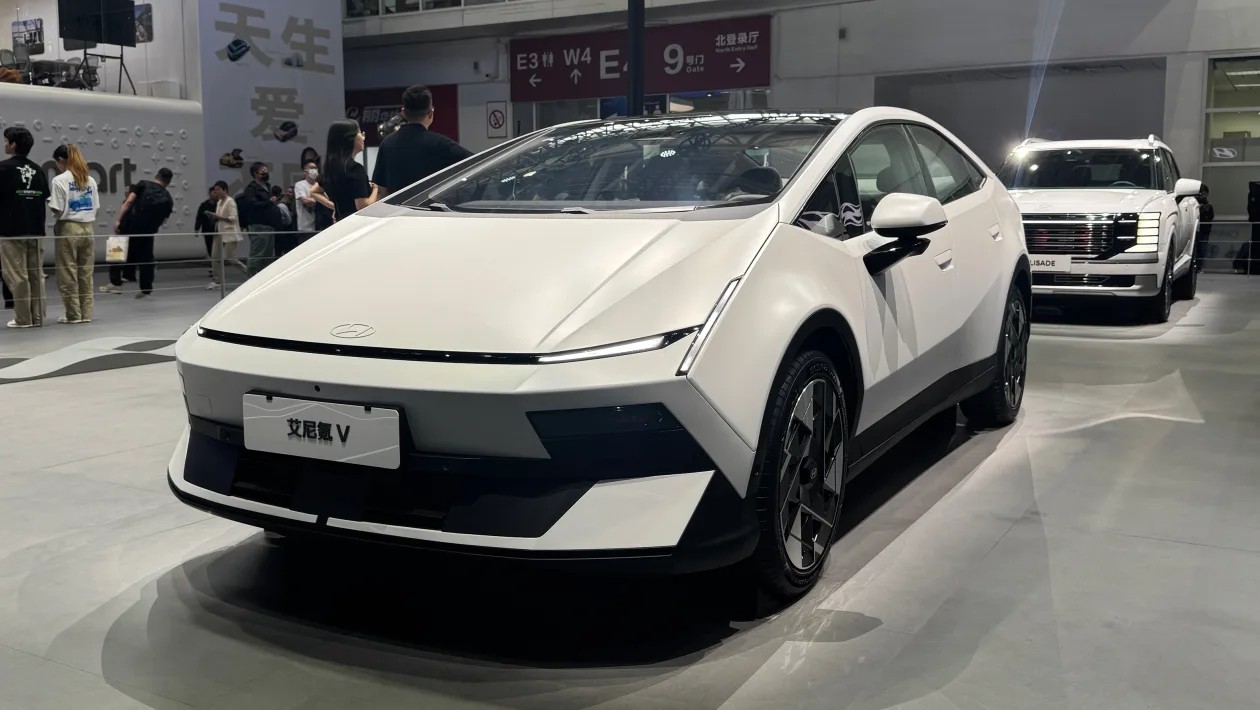
Hyundai has officially pulled the wraps off the Ioniq V, a new mid-size electric saloon designed to take on the Tesla Model 3. Featuring a striking, arrow-shaped silhouette and a radical interior, the vehicle represents a bold step in Hyundai’s strategy to capture the rapidly evolving Chinese electric vehicle (EV) market.
A Design Born from Concept
The Ioniq V is a rapid evolution of the recently revealed Venus concept car. Hyundai has moved quickly to transition the concept’s futuristic aesthetics into a production-ready model.
Key design elements include:
– Arrow-shaped silhouette: A distinctive profile that emphasizes aerodynamics and modern styling.
– Frameless doors: Integrated to minimize body shutlines and create a smoother, more cohesive look.
– Traditional door handles: While the concept may have featured “hidden” motorized units, the production model uses standard handles to comply with Chinese regulatory bans on certain automated door mechanisms.
Tech-First Interior vs. Global Standards
The most significant departure from Hyundai’s global lineup is found inside the cabin. While European models like the Ioniq 3 retain physical controls for ease of use, the Ioniq V is built for a tech-savvy Chinese demographic that embraces digital interfaces.
The dashboard is dominated by a massive 27-inch touchscreen that spans the entire width of the cabin. In a move toward minimalism, Hyundai has eliminated the traditional instrument cluster behind the steering wheel, opting instead for a high-mounted head-up display (HUD) to communicate speed and range to the driver.
This “screen-first” approach highlights a growing trend in the Chinese EV market: consumers are increasingly prioritizing connectivity and large-scale digital integration over tactile, physical buttons.
Performance and Market Strategy
Developed through a joint venture with the Chinese automaker BAIC, the Ioniq V utilizes battery technology from CATL. While specific technical specs remain limited, Hyundai has shared key performance targets:
- Range: Up to 372 miles based on the Chinese CLTC cycle.
- Estimated Global Equivalent: This translates to approximately 300 miles under the European WLTP standard.
While this range sits below the benchmarks set by some Tesla models, it reflects a shift in market priorities. In many Chinese segments, ultra-long range is often secondary to advanced software, smart connectivity, and interior luxury.
Will the Ioniq V Go Global?
Currently, the Ioniq V is being positioned as part of Hyundai’s “China offensive,” meaning it is not expected to launch in the UK or other major global markets immediately.
However, history suggests the door isn’t entirely closed. Hyundai has previously taken China-specific models—such as the Nexo hydrogen vehicle—and successfully rolled them out to international markets like Australia. Whether the Ioniq V follows this path depends on how well its tech-heavy, digital-centric philosophy resonates with drivers outside of China.
The Ioniq V marks a strategic pivot for Hyundai, proving that the brand is willing to tailor its design and technology specifically to the unique demands of the Chinese consumer.
In summary, the Ioniq V is a high-tech, design-forward electric saloon specifically engineered to compete in China’s digital-first EV landscape, leaving observers to wonder if its radical interior will eventually find a home in global markets.